
Anglesey (Ynys Môn) is Wales’s largest island, joined to the mainland near Bangor by two dramatic bridges and packed with enough beaches, castles and wildlife to fill several days rather than one. This guide brings together the best things to do on Anglesey, from the clifftop South Stack Lighthouse and the historic Menai Suspension Bridge to Newborough Beach, Anglesey Sea Zoo and the village with the famously long name, with practical prices, opening times and route planning for every stop.
At over 700 square kilometres, Anglesey is genuinely large enough that most visitors focus on one corner of the island rather than trying to cover it all in a single trip. The coastline alone runs to well over 100 miles, taking in everything from dramatic sea cliffs to some of the best beaches in Wales.
Wildlife is a genuine draw here too, with seabird colonies crowding the cliffs at South Stack, grey seals hauled out around Puffin Island, and red squirrels surviving on the island in numbers rare almost everywhere else in Britain. That mix of coastline and wildlife sets Anglesey apart from the mainland towns covered elsewhere on this site.
History runs just as deep, from Neolithic burial chambers and Bronze Age hut circles through to the medieval castle at Beaumaris and the engineering of Thomas Telford’s suspension bridge. Few islands this size pack in quite so many distinct eras of the past within such easy reach of each other.
This guide is organised around the island’s best-known stops, but it also covers quieter corners worth seeking out with more time to spare. Whether based on the island or visiting on a day trip from Bangor or Caernarfon, there’s enough here to help plan the visit properly.
| Attraction | Best For | How Long to Allow | Cost |
|---|---|---|---|
| South Stack Lighthouse | Clifftop views & lighthouse tour | 1.5–2.5 hours | Paid |
| RSPB South Stack Reserve | Seabird colonies & walking | 1–2 hours | Free (paid parking) |
| South Stack Coastal Path & Holyhead Mountain | Clifftop walk & ancient hillfort | 1–2 hours | Free |
| Menai Suspension Bridge | Engineering history & views | 15–30 minutes | Free |
| Britannia Bridge | Road & rail crossing views | 10–15 minutes | Free |
| Plas Newydd House and Gardens | Historic house, mural & strait views | 2–3 hours | Paid |
| Beaumaris | Historic town & castle | 2–3 hours | Paid |
| Bryn Celli Ddu Burial Chamber | Neolithic passage tomb | 30–45 minutes | Free |
| Newborough Beach & Llanddwyn Island | Dunes, beach walk & legend of Dwynwen | 2–4 hours | Free (paid parking) |
| Trearddur Bay | Family beach & watersports | 1–3 hours | Free (paid parking) |
| Red Wharf Bay | Wide sands & coastal path | 1–2 hours | Free (paid parking) |
| Din Lligwy Ancient Village | Romano-British village & burial chamber | 45–60 minutes | Free |
| Moelfre & RNLI Seawatch Centre | Lifeboat history & harbour village | 45 minutes–1 hour | Free |
| Amlwch Port & Parys Mountain | Copper mining history & moonscape walk | 1–1.5 hours | Free |
| Cemaes Bay & Cemlyn Nature Reserve | Harbour village & tern colony | 1.5–2 hours | Free |
| Anglesey Sea Zoo | Marine life & families | 2–3 hours | Paid |
| Oriel Ynys Môn | Island art & history museum | 1–1.5 hours | Free |
| Llanfairpwllgwyngyllgogerychwyrndrobwllllantysiliogogogoch | Novelty village & photos | 20–40 minutes | Free |
| Holyhead | Port town & ferry gateway | 1–2 hours | Free |
Visit South Stack Lighthouse and the RSPB Reserve
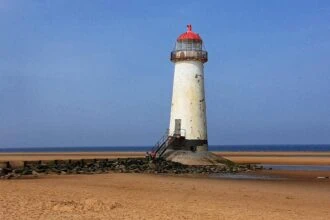
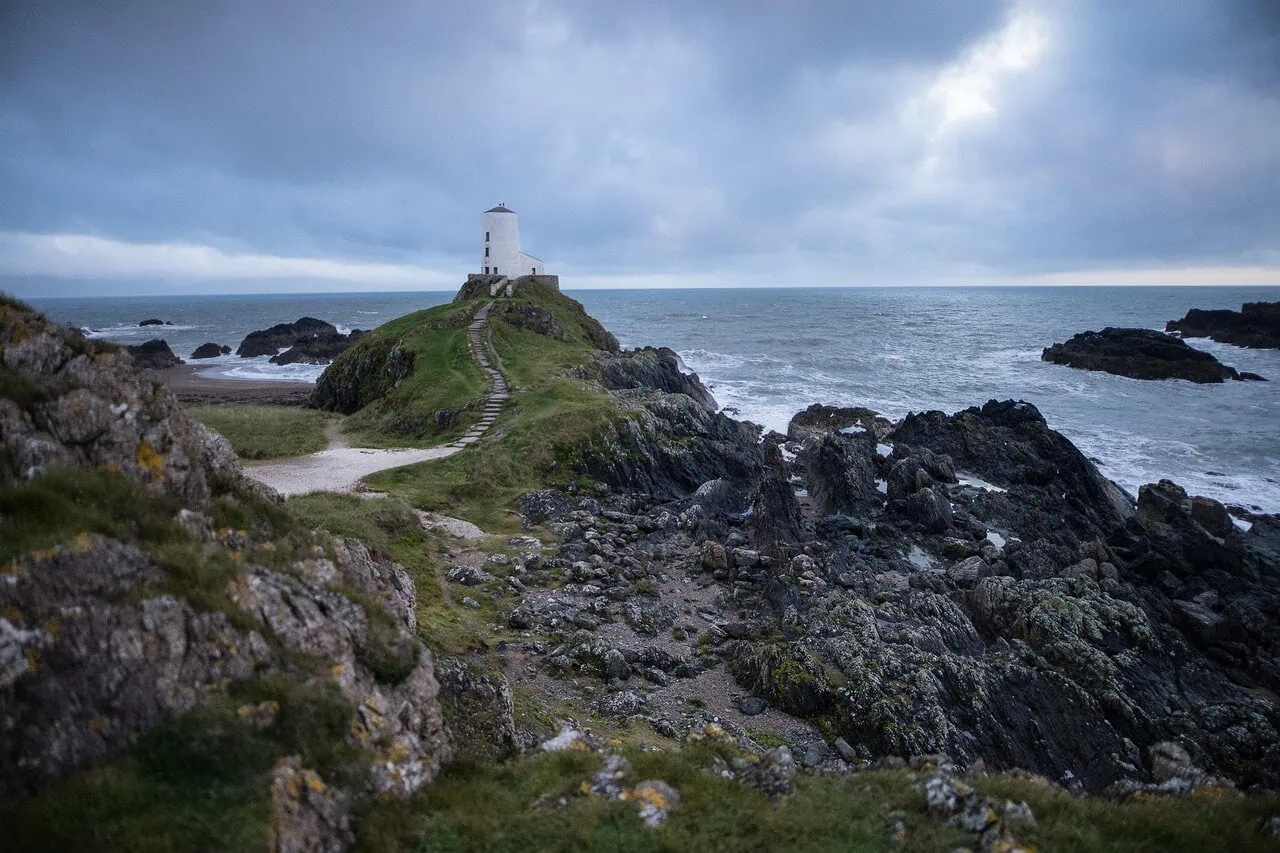
South Stack Lighthouse sits on a small islet off Holy Island, connected to the Anglesey coast by an aluminium footbridge and reached down more than 400 stone steps cut into the cliff. It’s one of the most dramatic short walks on the island, with the sea visible on both sides for much of the descent.
The lighthouse was built in 1809 to guide ships past the treacherous rocks off Holyhead, and the 28-metre tower still operates today under the remote control of Trinity House. Visitors can climb inside on open days and reach the lantern room, with views back along the cliffs towards Anglesey on a clear day.
The steps down are steep and uneven in places, so it’s worth allowing extra time and wearing proper footwear rather than sandals. It’s not a trip to rush, since the return climb back up feels considerably harder than the descent.
Admission runs from £5.00 (€5.75/$6.35) for a child aged 5 to 16 to £10.00 (€11.50/$12.70) for an adult. It opens daily from 21 March to 13 September 2026, weather permitting, with shorter hours on Fridays, so it’s worth checking ahead before making the drive out.
The surrounding RSPB South Stack reserve is free to enter and one of the best places in Wales to watch seabirds. Guillemots, razorbills, puffins, kittiwakes and rare red-billed choughs all nest on the cliffs each spring and summer, making it a genuine highlight even without descending to the lighthouse itself.
Parking costs £3.50 (€4.02/$4.45) for up to an hour or £7.50 (€8.62/$9.53) for the day, and Ellin’s Tower is a good place to start, with volunteers often on hand during nesting season to point out what’s on the cliffs. The reserve and lighthouse combine easily into a single visit of an hour and a half to two and a half hours.
South Stack Coastal Path and Holyhead Mountain
The cliffs above South Stack rise to Holyhead Mountain (Mynydd Twr), Anglesey’s highest point at 220 metres, reached by a network of way-marked paths from the RSPB car park. It’s one of the best short walks on the island, with views to Ireland on a clear day and back across the strait towards Snowdonia.
The summit is crowned by Caer y Twr, an Iron Age hillfort later reused as a Roman watchtower, and the lower slopes hold around twenty prehistoric hut foundations known as Cytiau’r Gwyddelod. Together they add roughly 4,000 years of human occupation to an already dramatic clifftop walk.
A gentler coastal stretch runs north and south from the lighthouse car park past Ellin’s Tower towards North Stack, following the clifftop on level ground with regular benches. It suits anyone who’s already tackled the 400 steps down to the lighthouse and wants a flatter alternative.
The full circular route over the summit and back takes most walkers 90 minutes to two hours, while the coastal sections can be done in far less. Both are free and share the same car park used for the lighthouse and RSPB reserve, so either combines easily with a lighthouse visit.
Paths can be exposed and uneven, particularly after rain, so proper footwear is worth having even in summer, and several stretches run close to unfenced cliff edges. It’s not a route to let children run ahead on unsupervised.
See hotel options and places to stay for your trip.
Browse hotelsBrowse apartments, holiday homes and self-catering stays.
View rentalsCompare hotel deals from multiple booking sites in one search.
Compare pricesCross the Menai Suspension Bridge and Britannia Bridge
Anglesey has been linked to the mainland near Bangor since 1826, when engineer Thomas Telford completed the Menai Suspension Bridge, one of the world’s first major suspension bridges built for road traffic. Its main span stretches 176 metres across the Menai Strait, hung from wrought iron chains that were later replaced with steel.
It remains a working road crossing today rather than a static monument, and it’s still a genuinely striking piece of Georgian engineering to drive or walk across. A footway runs alongside the traffic lanes, giving good views down to the fast-moving water of the strait below.
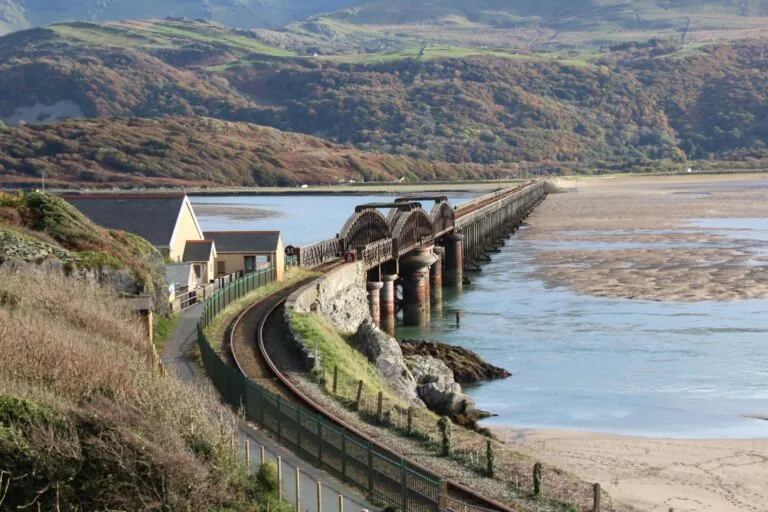
Alongside it runs the Britannia Bridge, originally built by Robert Stephenson in 1850 to carry the railway and rebuilt after a fire in 1970 to carry both road and rail on two levels. It’s less picturesque than its neighbour but carries the bulk of the traffic onto the island, including the A55 dual carriageway.
Crossing either bridge is free, and there’s no real need to stop specifically to appreciate them, since most visitors see both simply by driving onto Anglesey. The best photo spots are from the shoreline paths on either side of the strait rather than from the bridges themselves.
The water below, known as the Menai Strait, is popular with kayakers and anglers taking advantage of its fast tidal currents. It’s worth a short stop at the Belgian Promenade in Menai Bridge town if you want a closer look before continuing on to the rest of the island.
Plas Newydd House and Gardens
Plas Newydd is a National Trust country house on the shore of the Menai Strait, built for the Marquess of Anglesey, with some of the finest strait-side views on the island framing Snowdonia across the water. It pairs one of Anglesey’s grandest interiors with genuinely spectacular grounds.
The highlight indoors is Rex Whistler’s mural, a 58-foot trompe l’oeil landscape painted across the dining room wall in the 1930s, alongside a military museum covering the Battle of Waterloo. The gardens run to 169 acres, including a woodland walk, an Australasian arboretum and a summer terrace looking across the strait.
Most visitors spend two to three hours here between house and grounds, longer with a cafe stop or a full circuit of the woodland paths. The site sits right on the strait shoreline, so it’s an easy add-on to a day spent around the bridges or Sea Zoo.
Admission runs from £7.00 (€8.05/$8.89) for a child aged 5 to 17 to £14.00 (€16.10/$17.78) for an adult, and the house opens daily between late February and early November, with the garden open longer through the year. Parking is free for all visitors, unusual for a property of this size.
It’s reached down a signed drive off the A4080, a few minutes from Llanfairpwllgwyngyll and around ten minutes from the Menai bridges, making it one of the easier stops to fold into a day exploring the strait.
Explore Beaumaris
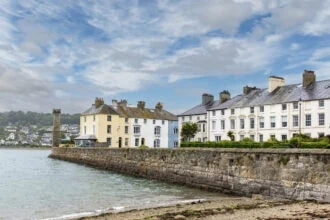
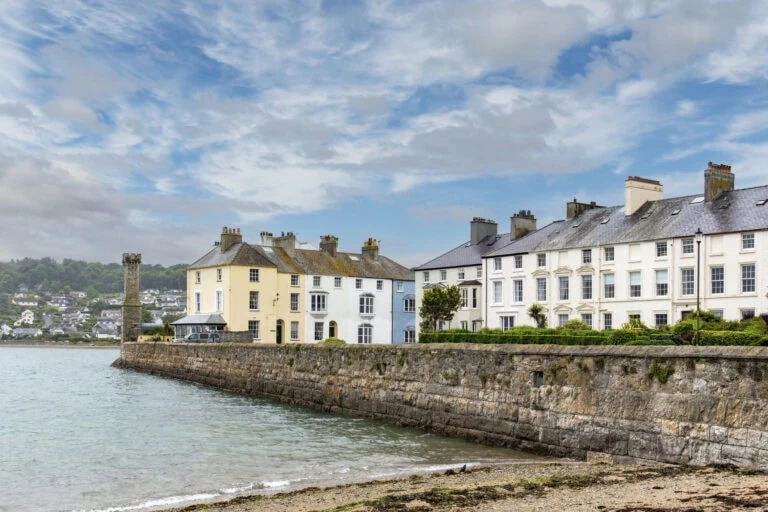
Beaumaris is Anglesey’s best-known historic town, built around a working harbour and looking out towards Puffin Island and the Snowdonia coastline beyond. It grew up around the castle rather than the other way round, and that relationship still shapes the layout of the town today.
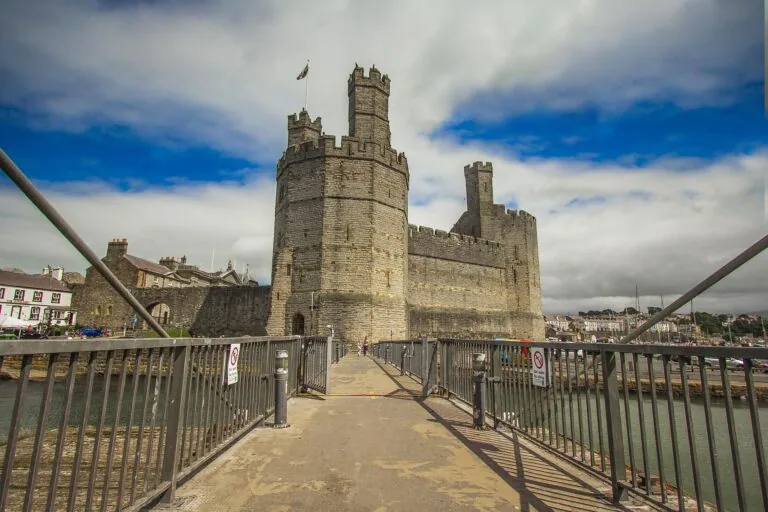
The town is home to the last and largest of Edward I’s castles in Wales, begun in 1295 as part of the same UNESCO World Heritage building campaign as Conwy and Caernarfon. Its symmetrical concentric walls and wide moat make it one of the most technically accomplished castles in Britain, even though it was never fully finished.
The moat still holds water on most sides, and it’s possible to walk a full circuit of the walls for views back across the town and out towards the strait. It’s a smaller castle to explore than Conwy or Caernarfon, so most visitors get around comfortably in under an hour.
The town itself is worth a wander too, with Georgian buildings, an old gaol and courthouse, and cafés and shops lining the streets near the harbour. Beaumaris rewards a dedicated visit in its own right, and our full Things to Do in Beaumaris guide covers the castle, courthouse, gaol and Puffin Island boat trips in far more depth than fits here.
Bryn Celli Ddu Burial Chamber
Bryn Celli Ddu (“the mound in the dark grove”) is Anglesey’s best-known prehistoric monument, a Neolithic passage tomb built around 3000 BC on the site of an even earlier stone circle. It’s one of the most complete tombs of its type in Wales, and a genuinely atmospheric stop for anyone interested in the island’s deep history.
A narrow passage leads into a chamber beneath the mound, and on the summer solstice each June, sunrise light travels the full length of the passage to illuminate the chamber, a deliberate alignment built into the tomb almost five thousand years ago. A replica of one of its carved stones stands nearby, the original having been moved to the National Museum Cardiff.
The site is free to enter and cared for by Cadw, open during daylight hours all year round, with a short footpath leading from a small roadside layby to the mound itself. Most visits take 30 to 45 minutes, longer if you linger to explore the surrounding fields.
It sits near Llanfairpwllgwyngyll and Brynsiencyn, a short drive from the Menai bridges and close enough to Anglesey Sea Zoo to combine both into one loop around the strait. There’s no visitor centre or facilities on site, so it suits a quick, self-guided stop rather than a longer planned visit.
The layby parking is limited, so arriving outside peak midsummer weekends makes for a quieter, easier visit, particularly if you want time to appreciate the passage without a queue behind you.
Newborough Beach and Llanddwyn Island
Newborough Beach backs onto one of the largest dune systems in Britain, alongside a Corsican pine forest planted in the 1950s to help stabilise the shifting sand. Way-marked trails wind through the pines, and red squirrels are occasionally spotted here, one of relatively few strongholds left in Wales.
At low tide you can walk out across the sand to Ynys Llanddwyn (Llanddwyn Island), home to the ruined chapel of Dwynwen, the Welsh patron saint of lovers, plus a row of restored pilots’ cottages and two small lighthouses. The island takes its name from Dwynwen’s own legend, and remains a place of pilgrimage on her feast day each January.
It’s worth checking tide times before setting out, since the sandy causeway linking the beach to the island can flood at high tide and cut it off for a couple of hours either side. The walk out and back covers around three miles, so it’s more of a proper outing than a quick stroll.
Parking costs £5.00 (€5.75/$6.35) for up to two hours or £15.00 (€17.25/$19.05) for the full day, reflecting how popular the beach gets in summer. Allow at least two hours for the walk out to Llanddwyn Island and back, more if you want to explore the lighthouses and chapel ruins properly.
It’s reached down a signed lane off the A4080 south of Brynsiencyn, around 20 minutes from the Menai bridges and a similar distance from Beaumaris, making it an easy stop on a loop around the southern half of the island.
Trearddur Bay
Trearddur Bay, on the west coast of Holy Island near Holyhead, is a Blue Flag beach with clear, sheltered water that makes it one of Anglesey’s most popular spots for families and watersports. Its broad crescent of sand and gently shelving shallows keep it calmer than much of the surrounding coastline.
Sailing, kayaking and paddleboarding are all common sights offshore, and the local sailing club runs regular racing through summer. It’s also popular for coasteering and snorkelling around the rocky headlands at either end of the beach.
Rock pools appear at low tide along the bay’s rockier edges, good for an hour of exploring with children, and a village with cafes, a pub and a sailing club sits right behind the beach. It makes an easy half-day stop rather than a special trip on its own.
The village has a handful of independent shops and good places to eat, so it works as well as a lunch stop as a beach visit. Public toilets and a small car park sit on the seafront, though spaces fill quickly on warm weekends.
It’s around ten minutes’ drive from Holyhead and roughly 15 minutes from South Stack, making it easy to combine with either as part of a day exploring Holy Island’s western coastline.
Entry to the beach is free, with only the car park charging a small fee, and the water here is monitored as one of the cleanest bathing spots on the island.
Search flights and useful route combinations in one place.
View flightsBrowse Airalo eSIM options for convenient travel data.
Check eSIMsArrange a private pickup before travel instead of sorting transport after landing.
Book a transferRed Wharf Bay
Red Wharf Bay (Traeth Coch), on Anglesey’s calmer east coast, is known for the huge expanse of sand exposed at low tide, when the bay empties into what feels like a small inland sea stretching to the horizon. It’s one of the island’s most striking sights at the right point in the tide cycle.
A row of pubs and restaurants lines the shore at Pentraeth, including the well-known Ship Inn, making this one of the few Anglesey beaches where a proper meal is part of the visit. The bay setting towards Snowdonia is hard to beat on a clear evening.
It’s a favourite starting point for walks along the Anglesey Coastal Path, with routes heading north towards Benllech and south towards Llanddona along low cliffs and farmland above the shore. Both directions offer genuinely quiet stretches of coastline away from the main beach.
The scale of the bay at low tide can be deceptive, and the tide comes in quickly across the flat sand, so it’s worth checking tide times before walking out any distance. Softer mud in places makes it worth sticking to firmer sand near the shoreline.
Parking is available in Pentraeth village and at a couple of points above the beach, with a small charge at the main car park. It pairs naturally with a stop at one of the waterfront pubs afterwards, particularly out of season.
It sits around 15 minutes from Beaumaris and a similar distance from Moelfre, making it a natural link between the castle town and the villages further up the east coast.
Din Lligwy Ancient Village
Din Lligwy is one of the best-preserved Romano-British settlements in Wales, a walled village of round and rectangular stone buildings occupied through the 3rd and 4th centuries AD, though the site may have been in use even earlier. It’s a genuinely evocative place to explore, tucked into a small wooded enclosure near Moelfre.
The village covers roughly a quarter of a football pitch, ringed by a stone wall up to five feet thick, with the foundations of two round huts and several rectangular buildings still clearly visible. Finds of coins, pottery and glass suggest the rectangular structures served as barns and workshops for a farming community rather than homes.
A short walk away sits Lligwy Burial Chamber, a Neolithic tomb with an enormous capstone balanced on low stone supports, plus the ruined medieval chapel of Capel Lligwy. Together the three sites make a compact loop through thousands of years of history in under an hour.
All three are free to visit and cared for by Cadw, reached down narrow lanes from a small parking area, with the hut group open from 10am to 4pm and the burial chamber and chapel accessible at any reasonable time. Allow 45 to 60 minutes to see all three properly.
It sits a few minutes’ drive from Moelfre and around 15 minutes from Red Wharf Bay, making it an easy addition to a morning spent along the east coast rather than a destination that needs its own trip.
Moelfre and the RNLI Seawatch Centre
Moelfre is a small fishing village on Anglesey’s east coast with a genuine claim to being one of the most important lifeboat stations in Britain, thanks to a string of dramatic rescues stretching back nearly two centuries. Its sheltered cove, whitewashed cottages and working harbour make it one of the prettiest stops on this side of the island.
The RNLI Seawatch Centre on the seafront tells that story in detail, built around a restored 1970s lifeboat and exhibits covering the wreck of the Royal Charter in 1859 and double gold medallist coxswain Richard “Dic” Evans. A viewing deck looks straight out over the bay towards the current lifeboat station.
The centre is free to enter, open daily through summer and on a shorter winter schedule, with a small RNLI shop and cafe-style seating inside. Most visits take 45 minutes to an hour, including time on the viewing deck watching for passing boats.
The village itself is worth a short wander too, with a handful of cafes and a pub near the harbour, plus a small shingle-and-sand beach that’s popular with local swimmers rather than sunbathers. Wreck relics from past rescues sit in the car park as an informal outdoor display.
Moelfre sits roughly ten minutes from Din Lligwy and 15 minutes from Red Wharf Bay, making it a natural stop between the two on a drive up Anglesey’s eastern coastline.
Browse hostels and budget-friendly stays.
See hostelsAccess compensation support, eligible lounge benefits and faster payouts.
See the benefitsUse convenient luggage storage between arrival, check-in and departure.
Check storageAmlwch Port and Parys Mountain
Amlwch Port, on Anglesey’s north coast, grew into one of the busiest ports in 18th-century Britain on the back of copper mined from the mountain immediately above the town. At its peak it shipped ore from what was then the largest copper mine in the world, and the harbour’s Georgian warehouses still hint at that boom-town past.
Above the town, Parys Mountain is the real draw, a genuinely otherworldly landscape of orange, purple and ochre spoil heaps and exposed rock left behind by centuries of open-cast mining. A free way-marked trail loops around and across the old workings, taking in viewpoints, shafts and the remains of a 19th-century windmill used to pump water from the mine.
The circular walk takes most visitors 60 to 90 minutes, over ground that’s uneven and occasionally steep, so it’s not a route for pushchairs. The site is open access at all times and free to visit, with no facilities on the mountain itself.
The town’s Copper Kingdom heritage collection, previously displayed at the harbourside Sail Loft, is currently in storage while a new permanent centre is developed on Parys Mountain, so it’s worth checking locally before planning a visit around it specifically. The port and mountain themselves remain fully open regardless.
Amlwch sits around 20 minutes’ drive from Moelfre and a similar distance from Cemaes Bay further along the coast, making it a sensible stop between the two on a loop of Anglesey’s north side.
Cemaes Bay and Cemlyn Nature Reserve
Cemaes Bay is Anglesey’s most northerly village, a small working harbour wrapped around a sandy beach that’s sheltered enough for swimming even when the open coast nearby is rough. It’s a genuinely pretty stop, with a handful of cafes and pubs looking out over the harbour wall.
A short walk west along the coastal path leads to Cemlyn Bay, a nature reserve built around a shingle-ridge lagoon that hosts one of the UK’s largest tern colonies each summer. Sandwich, Arctic and common terns all nest here in their thousands, watched over by wardens from the North Wales Wildlife Trust between May and July.
The reserve is free to visit, with a roadside car park and a low bank running along the ridge that doubles as a viewing point without disturbing the birds. Binoculars are worth bringing, since much of the colony nests some distance out on the shingle itself.
Most visitors combine 30 to 45 minutes at Cemlyn with an hour or so in Cemaes village itself, making a loop of around two hours in total including the coastal path between the two. Outside the breeding season the lagoon is quieter but still a good spot for other waders and wildfowl.
Cemaes sits roughly 20 minutes from Amlwch along the coast road, making it a natural final stop on a drive around Anglesey’s northern tip before heading back south towards Llangefni or the bridges.
Visit Anglesey Sea Zoo
Anglesey Sea Zoo, near Brynsiencyn on the shore of the Menai Strait, is one of the island’s most popular family attractions, with tanks recreating local marine habitats alongside sharks, rays, seahorses and a walk-through ocean tunnel. It’s built around genuinely local wildlife rather than imported exotics, which makes it a good complement to a day spent looking for seabirds elsewhere on the island.
The ocean tunnel is usually the highlight for younger visitors, giving a close-up view of fish swimming overhead, and there’s a dedicated seahorse breeding programme that’s one of the more unusual displays on site. Touch pools let children handle crabs and other shallow-water creatures under staff supervision.
Most families spend two to three hours here, longer if there’s a talk or feeding session timed during the visit. It’s an easy indoor option for a wet day, since much of the site is under cover.
Admission runs from £12.50 (€14.37/$15.88) for a child aged 3 to 15 to £13.95 (€16.04/$17.72) for an adult. It’s open daily from 10am to 4:45pm, and tickets remain valid for return visits within six days of purchase, which suits a longer island stay.
It sits close to the Menai Strait and both bridges, so it combines easily with a stop at Beaumaris or a walk along the strait afterwards. Booking online in advance is worth doing in peak summer weeks, when the car park can fill by early afternoon.

Oriel Ynys Môn
Oriel Ynys Môn, on the edge of Llangefni in the middle of the island, is Anglesey’s main museum and art gallery, telling the story of the island from prehistory through to the present day. It’s a good option for a rainy afternoon or as a change of pace from the coastline.
The permanent Ancestral Anglesey gallery covers everything from Bronze Age burials to the Victorian era, while the attached Oriel Kyffin gallery is dedicated to the work of Sir Kyffin Williams, the Anglesey-born painter best known for his thick-textured landscapes of Snowdonia. A programme of changing exhibitions keeps the contemporary side of the building fresh.
Admission is free, and the museum is open Tuesday to Sunday plus bank holiday Mondays, with a cafe on site for a break between galleries. Most visitors spend an hour to 90 minutes here, longer if a temporary exhibition catches your interest.
It sits just off the A5 on the edge of Llangefni, roughly central on the island and around 20 minutes from both Beaumaris and Anglesey Sea Zoo, making it an easy addition to a day that’s otherwise spent outdoors.
There’s a small free car park on site, and the museum works well as an indoor pause partway through a longer island itinerary rather than a destination requiring a special trip of its own.
Stop at Llanfairpwllgwyngyllgogerychwyrndrobwllllantysiliogogogoch
Llanfairpwllgwyngyllgogerychwyrndrobwllllantysiliogogogoch, usually shortened to Llanfairpwll or Llanfair PG, holds the record for the longest place name in the UK at 58 letters. It’s one of the most photographed signs in Wales, and most visitors stop here purely for the novelty rather than any particular sight.
The extended version was reportedly coined in the 19th century to draw curious visitors, built up from the village’s short original name plus a string of local topographical details rather than reflecting any genuine ancient usage. It worked, and the name has been drawing travellers off the main road ever since.
The village railway station displays the full name on its platform sign, a popular photo stop for passing travellers, and nearby shops sell postcards, tickets and souvenirs printed with the tongue-twisting name in full. Staff at the station are used to visitors asking for help with the pronunciation.
It’s a quick, slightly novelty stop rather than a destination in itself, and most people are on their way again within 20 to 40 minutes. It’s free to visit, and there’s no admission charge beyond whatever you choose to buy in the gift shop.
It sits just off the main road between the bridges and the rest of the island, making it easy to fold into a wider day out rather than requiring a special trip. It works well as a first or last stop for anyone crossing between the mainland and Anglesey.
Take a Puffin Island Boat Trip
A Puffin Island boat trip is one of the best ways to see Anglesey’s wildlife from the water, with sightseeing cruises departing from Beaumaris Pier and travelling along the Menai Strait towards the island off the eastern tip of Anglesey.
Known in Welsh as Ynys Seiriol, Puffin Island is a protected nature reserve rather than somewhere sightseeing boats normally land. Cruises instead circle or approach the island from the water, giving passengers views of its cliffs, seabirds and the surrounding coastline.
Despite the name, puffins aren’t guaranteed. They are seasonal visitors and are considerably less numerous here than some of the island’s other seabirds. Depending on the time of year, there are better chances of seeing guillemots, razorbills, cormorants and other seabirds around the island.
Grey seals are another highlight, regularly seen resting around the rocks or swimming close to the island. Dolphins and porpoises are possible too, although sightings are unpredictable and shouldn’t be expected on every sailing.
The journey is also worthwhile for the scenery. Looking back from the water gives excellent views towards Penmon Point, Beaumaris and the mountains of North Wales, while the trip through the Menai Strait provides a completely different perspective on Anglesey’s eastern coastline.
Sailings are weather and sea-condition dependent, so check departures before travelling and allow some flexibility if you’re visiting during unsettled weather. Puffin Island cruises combine particularly well with Beaumaris Castle, the pier and historic town centre, and our Things to Do in Beaumaris guide covers the town in considerably more detail.
Explore Penmon Priory and Penmon Point
The eastern tip of Anglesey around Penmon combines medieval history, coastal scenery and one of the island’s most recognisable lighthouse views. It’s close enough to Beaumaris to visit on the same day but feels considerably more remote once you reach the coast.
Penmon Priory developed from an early Christian community traditionally associated with St Seiriol, who is believed to have established a religious settlement here during the 6th century. Parts of the surviving church and monastic buildings date from the medieval period, while carved crosses provide evidence of the site’s much earlier importance.
Nearby is St Seiriol’s Well, reached by a short walk from the priory. The stone-built holy well is another reminder that people were making religious journeys to this corner of Anglesey long before the island became a modern tourist destination.
Continue towards the coast and you eventually reach Penmon Point, looking across the water towards Puffin Island. Just offshore stands the distinctive black-and-white Trwyn Du Lighthouse, built during the 19th century to protect shipping navigating the eastern entrance to the Menai Strait.
The point is particularly good for coastal photography and wildlife watching, with seabirds around the offshore islands and occasional marine mammals in the surrounding water. On a clear day, the mountains across the water make the setting even more dramatic.
Penmon is best treated as a combined visit rather than rushing between individual sights. Allow around one and a half to two hours for the priory, well and coastline, longer if you want to walk or spend time watching wildlife at the point.
Walk to Aberffraw Beach
The small village of Aberffraw provides access to one of the quieter stretches of sand on Anglesey’s southwest coast. Unlike the more developed beaches at Trearddur Bay, reaching the beach here involves a pleasant walk alongside the Afon Ffraw before the landscape suddenly opens onto the coast.
From the village, follow the river towards the sea through a landscape of dunes and open countryside. The walk itself is part of the attraction and means the main beach feels much more secluded than places where visitors can park immediately beside the sand.
At the coast you’ll reach Traeth Mawr, an enormous sandy beach backed by dunes. There is plenty of room even during busier periods, making it particularly appealing to visitors who want a long beach walk rather than cafés, amusements and other resort facilities.
The Anglesey Coastal Path passes through the area, so stronger walkers can continue beyond the beach rather than simply returning to Aberffraw. The surrounding coastline includes rocky headlands, smaller coves and extensive views across the Irish Sea.
Aberffraw itself has a much deeper history than its size suggests. It was once associated with the royal court of the Princes of Gwynedd, making the village an important political centre in medieval Wales long before the larger towns on modern Anglesey developed.
Access to the beach is free, and the walk from the village makes this better suited to visitors happy to explore on foot. Allow at least one and a half to two hours for a relaxed walk to the beach and back, considerably longer if you’re continuing along the coastal path.
Visit Melin Llynnon
Melin Llynnon, near Llanddeusant in northwestern Anglesey, is the island’s only surviving working windmill and one of the more unusual heritage attractions away from the coastline.
The tower mill dates from the 18th century and was built to grind locally grown grain. After falling out of regular use, it was restored and has become a reminder of the agricultural history that shaped much of rural Anglesey.
Visitors can see the windmill and its machinery while learning how grain was traditionally turned into flour before modern industrial milling. The machinery and confined interior make it quite different from the castles, burial chambers and mining remains elsewhere around the island.
The surrounding site has developed into more than just a historic windmill, making it particularly suitable for families and visitors exploring this quieter part of Anglesey. It is worth checking the current activities and opening arrangements before making a special journey, as these can vary through the year.
Melin Llynnon is also useful geographically. Much of the main Anglesey sightseeing circuit follows the southern and eastern coasts, while the windmill provides a reason to explore the rural northwest of the island between Holyhead and the northern coastline.
Allow around one to two hours, depending on what’s operating during your visit. It combines particularly well with Cemaes Bay, Cemlyn or another stop around northern Anglesey rather than requiring an entire day of its own.

Discover Barclodiad y Gawres
Barclodiad y Gawres is one of Anglesey’s most important prehistoric monuments, a Neolithic passage tomb dramatically positioned close to the coast near Porth Trecastell on the western side of the island.
Built thousands of years ago, the monument consists of a central chamber reached through a passage beneath a reconstructed mound. Its location overlooking the sea makes it particularly atmospheric and very different from Bryn Celli Ddu, Anglesey’s other famous Neolithic passage tomb.
What makes Barclodiad y Gawres especially significant is the presence of decorated stones within the monument. Spiral, zigzag and other carved designs connect the site with a wider tradition of Neolithic passage-grave art found around the Irish Sea.
The monument also provides evidence of prehistoric activity beyond burial alone. Archaeological investigation has revealed material suggesting people gathered and carried out activities at the site, adding to the mystery surrounding exactly how these large ceremonial monuments were used.
The coastal setting is part of the experience. Rather than standing beside a visitor centre or car park, the chamber is reached as part of a short walk through the surrounding landscape, with extensive views across Anglesey’s western coastline.
Access arrangements to the interior can vary, so check current information before travelling specifically to enter the chamber. Even when internal access isn’t available, the coastal walk and exterior remain worthwhile for anyone interested in Anglesey’s prehistoric past.
Combine it with Trearddur Bay or Holy Island for a broader day exploring the western side of Anglesey. Together with Bryn Celli Ddu and Din Lligwy, it helps demonstrate just how unusually rich the island is in surviving ancient sites.
Walk Part of the Anglesey Coastal Path
One of the best ways to experience Anglesey is on foot. The Anglesey Coastal Path follows almost the entire coastline of the island, linking beaches, cliffs, villages, nature reserves and historic sites into one long-distance route.
You don’t need to attempt the complete circuit. Some of the best parts of the path can be explored as short walks of an hour or two, making it easy to incorporate a section into a normal sightseeing day.
Around South Stack, the route crosses some of Anglesey’s most dramatic cliffs, passing seabird colonies and giving views towards the lighthouse. The stretch around Holyhead Mountain can be combined with the summit for one of the island’s more demanding short walks.
The eastern coastline offers gentler alternatives. Sections around Red Wharf Bay and Moelfre combine beaches, farmland and small coastal villages, while the paths around Penmon provide views towards Puffin Island and the North Wales mainland.
In the south, walking around Newborough and Llanddwyn combines forest, dunes and open beach, while the southwest around Aberffraw feels considerably wilder and less developed. These shorter sections mean visitors can experience very different parts of the path without committing to a multi-day trek.
The route is free to walk, although parking charges apply at some of the most popular starting points. Conditions vary enormously, from surfaced promenades and beaches to muddy fields, rocky paths and exposed clifftops, so footwear should match the section you’re tackling.
For most visitors, choosing one coastal-path section that fits naturally with another attraction works better than trying to make walking a separate part of the itinerary. South Stack, Red Wharf Bay, Moelfre, Penmon, Newborough and Aberffraw all make particularly easy combinations.
Holyhead: Anglesey’s Ferry Gateway to Ireland
Holyhead, on Holy Island at Anglesey’s western tip, is the island’s main port town and the busiest passenger ferry crossing point between Britain and Ireland. It’s a working port first and a tourist stop second, so most visitors pass through rather than lingering.
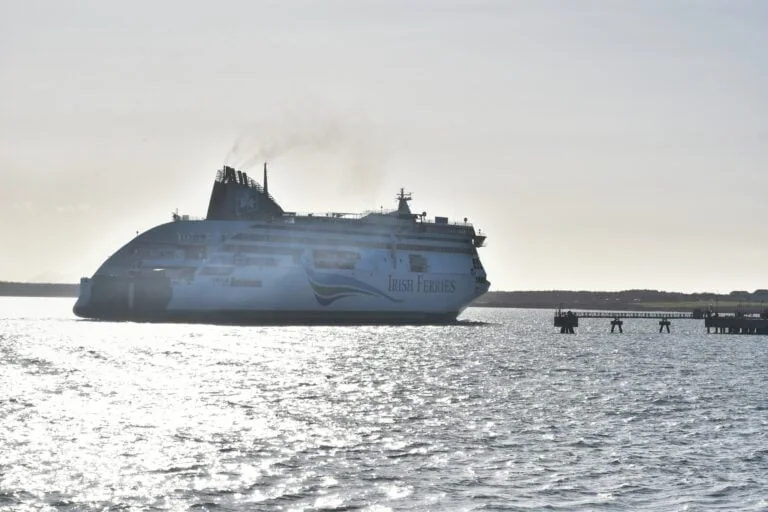
Both Stena Line and Irish Ferries run regular sailings to Dublin, with conventional crossings taking around 3 hours 15 minutes to 3 hours 30 minutes and the seasonal high-speed Dublin Swift cutting that to just over two hours. Booking ahead is worth doing in summer, particularly if you’re travelling with a car.
Holyhead sits at the end of the North Wales Coast Line, so it’s easy to reach by train as well as by road across the two bridges. The town itself has a small maritime heritage centre and a handful of cafés near the harbour if you have time before a sailing.
For full sailing times, prices and how to plan the crossing, see our Holyhead to Dublin Ferry guide, which covers every operator and departure in detail. It’s worth reading in advance if the ferry crossing is the main reason for your visit to this side of the island.

Best Things to Do on Anglesey With Children
Anglesey is a genuinely easy island for a family trip, with beaches, wildlife and a castle all within easy reach of each other. Anglesey Sea Zoo is the obvious highlight for younger children, with touch pools and a walk-through ocean tunnel that keep most ages entertained.
Newborough Beach and Trearddur Bay both give plenty of space to run around and paddle safely, with gently shelving sand that suits younger children. Older children tend to enjoy the climb around Beaumaris Castle and the novelty of posing under the sign at Llanfairpwllgwyngyllgogerychwyrndrobwllllantysiliogogogoch station.
The RSPB South Stack reserve works well for children too, with binoculars available to borrow at the visitor centre and a genuinely dramatic clifftop setting that keeps most ages interested. Just bear in mind the 400 steps down to the lighthouse itself, which are steep enough that not every family will want to attempt the full descent.
Best Free Things to Do on Anglesey
Anglesey is generous with free attractions. Crossing the Menai Suspension Bridge and Britannia Bridge costs nothing, and the RSPB South Stack reserve has free entry too, though parking is charged.
Red Wharf Bay and Trearddur Bay are both free to walk, with only the car parks charging a fee. The village sign at Llanfairpwllgwyngyllgogerychwyrndrobwllllantysiliogogogoch station is free to photograph too, and makes an easy stop on the way to or from the free beaches.
How Long Do You Need on Anglesey?
A focused day trip can cover South Stack, the Menai bridges and one beach, but Anglesey genuinely rewards two or three days given how spread out its attractions are. With more time, you can add Beaumaris, Anglesey Sea Zoo and a full circuit of the coastline rather than rushing between a handful of highlights.
Anglesey also works well as a base for exploring Snowdonia and the rest of North Wales, particularly for anyone travelling onward to or from the Holyhead ferry to Ireland, since it sits directly on the route between the two.
Getting to Anglesey
Anglesey is reached from the mainland near Bangor via the Menai Suspension Bridge or the neighbouring Britannia Bridge, both carrying the A55 and A5 roads onto the island. Both bridges are free to cross, and the short distance between them means traffic can back up at peak times, particularly in summer and around ferry departures from Holyhead.
By train, the North Wales Coast Line runs across the Britannia Bridge and along the island to Holyhead, with direct services from Chester, Bangor and beyond. See our North Wales Coast Line guide for full timetables and connections, and our Holyhead to Dublin Ferry guide if you’re continuing on to Ireland.

Rupert’s Handy Travel Tips
Heading to Anglesey? Here are a few useful tips to help you make the most of your visit:
- Check South Stack’s opening days first: the lighthouse operates weather permitting and keeps shorter hours on Fridays, so check the website before making the drive out to Holy Island.
- Book Sea Zoo tickets online: standard tickets stay valid for six days after purchase, so you can split your visit across two days without paying twice.
- Watch the tide for Llanddwyn Island: the sandy causeway out to Ynys Llanddwyn can flood at high tide, so check tide times before setting out from Newborough Beach.
- Wear proper shoes at South Stack: the 400 stone steps down to the lighthouse are steep and uneven, so trainers or walking shoes are far more comfortable than sandals.
- Allow extra time crossing the bridges in summer: traffic can back up near Holyhead around ferry departure times, so build in a buffer if you’re catching a sailing.
Want to meet the reindeer behind our travel tips? Find out more in our page Who is Rupert?.
Frequently Asked Questions
Is Anglesey worth visiting?
Yes. Anglesey combines a dramatic lighthouse and seabird colonies at South Stack, one of the world’s earliest major suspension bridges, a well-preserved castle town at Beaumaris and a genuine spread of beaches, all within an island small enough to explore properly over a couple of days.
How do you get to Anglesey?
By road, the island is reached from Bangor via the Menai Suspension Bridge or the Britannia Bridge, both free to cross. By train, the North Wales Coast Line runs across the Britannia Bridge and along the island to Holyhead.
What is the longest place name in the UK?
Llanfairpwllgwyngyllgogerychwyrndrobwllllantysiliogogogoch, a village on Anglesey usually shortened to Llanfairpwll or Llanfair PG, holds the record at 58 letters. The extended name was reportedly created in the 19th century to attract visitors.
Is South Stack Lighthouse open all year?
No. It operates daily from late March to mid-September, weather permitting, with shorter hours on Fridays. The surrounding RSPB reserve and coastal paths stay open year-round even when the lighthouse itself is closed.
Can you walk to Llanddwyn Island?
Yes. Ynys Llanddwyn is a tidal island reached on foot from Newborough Beach along a sandy causeway, though it’s worth checking tide times before you set out since the crossing can flood at high tide.
Is Anglesey good for a ferry crossing to Ireland?
Yes. Holyhead, on Anglesey’s western tip, is the main departure point for ferries to Dublin, with both Stena Line and Irish Ferries running regular sailings and a seasonal fast ferry cutting the crossing to just over two hours.
Further Reading & Related Guides
If you’re travelling on to Ireland after exploring Anglesey, our Holyhead to Dublin Ferry guide covers every operator, sailing time and price for the crossing from Holyhead. It’s a natural next step for anyone finishing an Anglesey trip at the ferry port rather than heading back across the bridges.
Anglesey sits at the western end of the North Wales Coast Line, so if you’re planning a wider rail trip along the coast towards Bangor, Conwy or Llandudno, that guide has full timetable and route detail for the whole line.
For the bigger picture of what else North Wales and the rest of the country have to offer, our Wales Travel Guide brings together the national parks, coastline and castles that pair naturally with a visit to Anglesey.