
The Great Orme is the vast limestone headland that rises above Llandudno, home to Britain’s only cable-hauled street tramway, its longest passenger cable car, and copper mines that were being worked 4,000 years before Llandudno existed as a town. Add sweeping coastal walking trails, a wandering herd of Kashmiri goats, an ancient hillside church and a scenic toll road circling the base, and the headland easily fills a full day. This guide covers every attraction on the Great Orme in depth, with current prices, opening seasons and practical tips for getting up and around.
Two very different ways reach the summit, the Victorian tramway climbing through the streets of the town before opening out onto the headland, and the cable car gliding above the hillside from Happy Valley near the pier. Riding one up and the other down is the classic way to see the headland, since each gives a genuinely different perspective on the climb.
The Bronze Age copper mines are the real historical heavyweight here, among the most significant prehistoric sites anywhere in Britain, with mining activity that continued for well over a thousand years. Alongside the mines, the Country Park’s walking trails and its resident herd of wild Kashmiri goats give the headland a genuine wildlife dimension too.
Marine Drive, the toll road that loops around the base of the Orme, offers an easy way to take in the cliffs and coastline without walking a step, and it connects naturally with quieter spots like St Tudno’s Church partway round. Between the rides, the mines, the walking and the wildlife, most visitors find a half day turns into a full one.
| Feature | Best For | How Long to Allow | Cost |
|---|---|---|---|
| Great Orme Tramway | A unique cable-hauled ride to the summit | About 1 hour return | Paid |
| Llandudno Cable Car | Scenic aerial views on the way up | 30–45 minutes return | Paid |
| Bronze Age Copper Mines | Genuinely ancient underground history | About 45 minutes | Paid |
| Country Park Walking Trails | Coastal views and the resident goats | 1–3 hours | Free |
| Marine Drive | A scenic drive around the headland | 30–45 minutes | Paid (toll) |
| St Tudno’s Church | A quiet, ancient hillside church | 15–20 minutes | Free |
| Summit Visitor Complex | Café, views and facilities | 30–60 minutes | Free entry |
| Dry Ski Slope & Toboggan Run | Family toboggan rides and skiing | 30–60 minutes | Paid |
| Kashmiri Goats | Spotting the headland’s famous wild herd | 30 minutes–1 hour | Free |
| Wildlife & Birdwatching | Choughs, seals and rare butterflies | 30–60 minutes | Free |
| Rock Climbing at Pen Trwyn | Watching or attempting world-class sport climbs | 10–30 minutes | Free |
The Great Orme Tramway
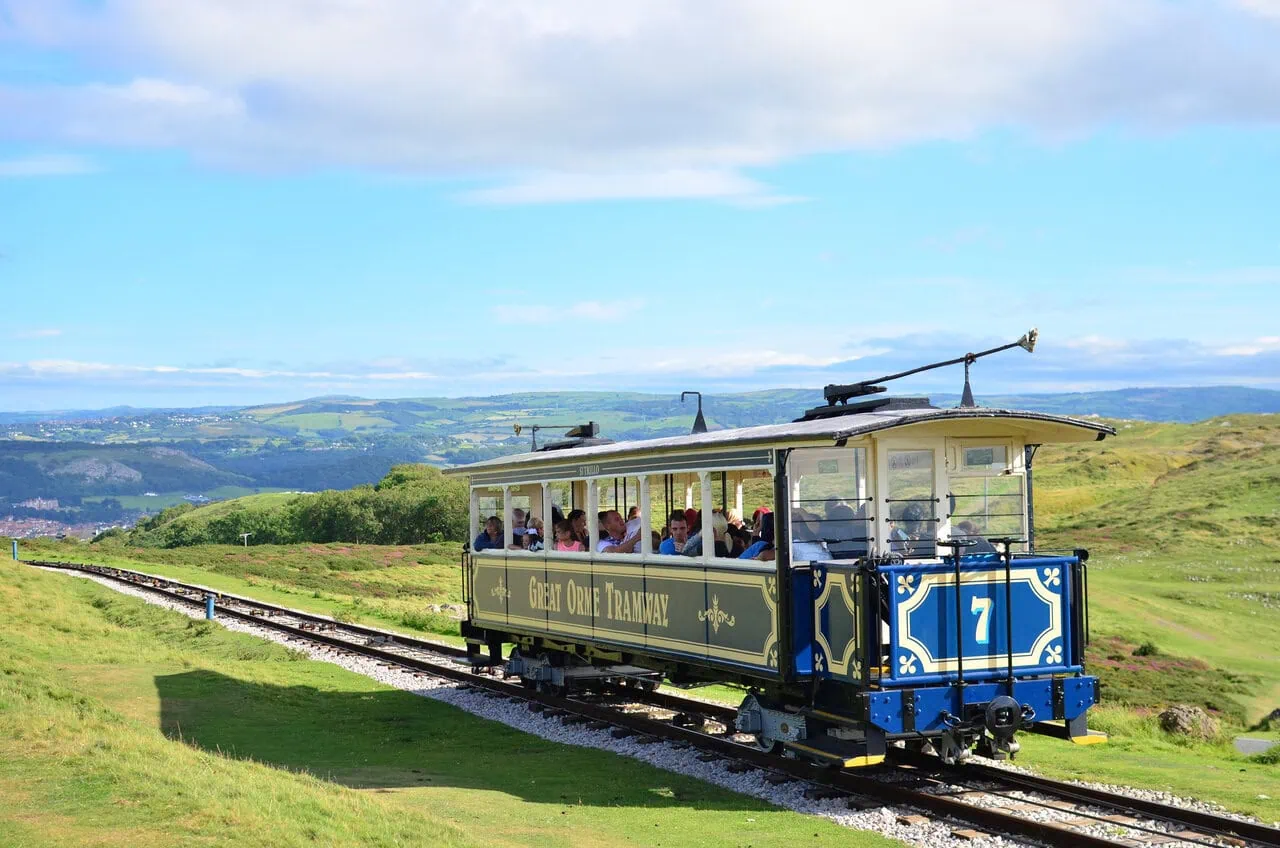
The Great Orme Tramway is Britain’s only remaining cable-hauled street tramway, and one of just a handful left anywhere in the world. It’s the headline reason many visitors come to the Great Orme, as much a piece of working Victorian engineering as a ride to the summit.
It opened in two stages, the lower half in 1902 and the upper half in 1903, and still carries over 200,000 passengers a year up the mile-long route from Victoria Station to the summit. Vintage tramcars, each named after a saint, are hauled by underground cables rather than an onboard engine, with a change of car at the Halfway station partway up.
The gradient is genuinely dramatic by tramway standards, with the lower section climbing as steep as 1 in 3.8 before the upper stretch eases to a gentler 1 in 10 near the summit. Sitting on the downhill side gives the best view of Llandudno’s bay opening out below.
The tramway runs seasonally from late March to late October, so it isn’t an option for a winter visit to the headland. A 2026 adult return costs £11.25 (€12.94/$14.29) in low season, rising to £12.30 (€14.15/$15.62) in July and August, with child returns (ages 3–16) at £8.05 (€9.26/$10.22) and £9.30 (€10.70/$11.81) respectively.
Cheaper single and halfway fares suit anyone who only wants to ride one direction. Queues can build at Victoria Station on busy summer afternoons, so travelling earlier in the day usually means a shorter wait.
The summit terminus sits right beside the visitor complex, so it’s easy to combine the ride with a coffee, the play area or a walk before heading back down. Many visitors ride the tramway up and the cable car down, or vice versa, since the two routes give genuinely different views of the headland.
The Llandudno Cable Car
The Llandudno Cable Car is billed as the longest passenger cable car system in Britain, running just over a mile from Happy Valley, above the pier, to the summit of the Great Orme. It opened in 1969 and remains a genuinely striking way to reach the top of the headland, gliding above the hillside rather than climbing it on rails.
Around 20 gondolas depart roughly every minute, each carrying up to four passengers on the nine-minute journey to the top. It’s a noticeably quieter, more open ride than the tramway, with uninterrupted views over Llandudno’s bay and the Little Orme opening out almost as soon as you leave Happy Valley.
Unlike the tramway, the cable car runs only from around Easter to the late October half-term, so its season is a little shorter and worth double-checking before planning a visit either side of summer. It also cannot operate in winds above 22mph, so it’s worth checking conditions before setting off on a blustery day.
Adult and child return fares both apply, though it’s cash only, with no cashpoint at either the summit or the Happy Valley station. It’s worth bringing enough cash for the whole party before setting off, since there’s nowhere nearby to withdraw money if you come up short.
The gondola glides above the same hillside the goats graze, so it’s often the best vantage point on the whole headland for spotting them from above. Photographers tend to get their clearest shots partway up, just before the gondola swings in over the summit plateau.
The cable car starts from Happy Valley, just above Llandudno’s pier, making it an easy add-on to a day that also takes in the seafront and pier itself. Many visitors ride it up and the tramway down, since starting and finishing at different points avoids retracing the same route on foot or by bus.
See hotel options and places to stay for your trip.
Browse hotelsBrowse apartments, homes and self-catering accommodation.
Browse rentalsCompare hotel prices across multiple booking sites.
Compare ratesDry Ski Slope & Toboggan Run
The Great Orme is also home to a dry ski slope and toboggan run, tucked into the hillside above Happy Valley near the cable car’s base. It’s a genuinely different way to spend an hour here, aimed squarely at families.
The toboggan track is regularly billed as one of the longest dry toboggan runs in Britain, winding downhill through bends and straights before looping back to the start. Riders control their own cart with a hand brake, suiting confident riders and nervous first-timers alike.
The adjoining ski slope offers lessons and open practice for skiing and snowboarding with qualified instructors. A snow-tubing area and a small alpine-themed mini-golf course round out the site for anyone not keen on skis or a cart.
Both the slope and the toboggan run only operate in dry conditions, so heavy rain can close them at short notice. The toboggan run welcomes walk-ups with no booking needed, though sno-tubing sessions are best pre-booked.
A 2026 toboggan session costs from £13.50 (€15.53/$17.15) for two rides, with children under four unable to ride and those aged four to seven needing an adult alongside. Ski and snowboard lessons are priced separately by package.
The centre sits just off Happy Valley Road, a short walk from the cable car’s lower station, making it an easy add-on to a gondola ride. Allow 30 to 60 minutes depending on how many activities you try.
The Bronze Age Copper Mines
The Great Orme Bronze Age Copper Mines are among the most significant prehistoric sites in Britain, with mining activity here beginning around 4,000 years ago and continuing for well over a thousand years. Early miners used stone hammers and animal bone tools to extract an estimated 1,760 tonnes of copper ore, working tunnels that are astonishingly extensive given the technology available at the time.
The self-guided tour takes around 45 minutes, combining a short introductory film with a 200-metre underground route through the original tunnels, plus a walk around the surface smelting area and opencast workings. Hard hats are provided, and sensible flat shoes are essential since the floor is uneven and the passages are dim and occasionally low-ceilinged.
The mines open mid-March to the end of October, from 9:30am with last admission at 4:30pm. 2026 admission costs £13.75 (€15.81/$17.46) for an adult and £8.25 (€9.49/$10.48) for a child aged 5 to 15.
It’s genuinely good value for the depth of history on offer, particularly for anyone interested in archaeology rather than just the headland’s views. It’s not fully accessible underground, so visitors with mobility concerns may prefer the surface smelting area and opencast workings instead.
The mines sit close to the tramway’s route partway up the headland, so they combine naturally with a ride up or a full day exploring the rest of the Country Park. Allow a little extra time either side of the tour for the ticket queue in peak season.
Great Orme Country Park & Nature Reserve
Great Orme Country Park and Nature Reserve covers most of the headland, protected as a Site of Special Scientific Interest and Special Area of Conservation for its rare limestone grassland. The wild cotoneaster that grows here is found nowhere else on Earth, making the reserve genuinely important to botanists as well as walkers.
Waymarked paths criss-cross the clifftops and summit plateau, ranging from gentle strolls near the tramway to longer coastal circuits further round the headland. On a clear day, the views stretch over Llandudno’s two bays towards Anglesey and Snowdonia, making even a short section of path worth the walk.
The Great Orme’s Kashmiri goats are one of its best-loved residents, descended from a pair presented to the royal Windsor herd in the early 1800s and later brought to the headland to help manage the steep grazing slopes. Around 60 animals now roam largely wild across the hillsides, rather than being kept in any single enclosure.
They occasionally wander into Llandudno itself, most famously during the 2020 lockdown, when footage of them exploring the empty streets made international news. Sightings are far from guaranteed, though the lower slopes near Marine Drive tend to be a reliable spot early or late in the day.
Both the paths and the goats are entirely free to enjoy, with no ticket or booking required at any point. It’s easy to combine an hour or two of walking with any of the paid attractions elsewhere on the headland, simply by starting or finishing near the tramway or cable car stations.
The Kashmiri Goats of the Great Orme
The Kashmiri goats of the Great Orme are among the most photographed residents of the headland, a wild herd that roams its cliffs and slopes largely undisturbed. Few British landmarks have an animal so closely associated with them as the Orme does with its goats.
The herd traces back to a pair of goats presented to King George IV, which founded the royal herd at Windsor. Major General Sir Savage Mostyn later brought breeding stock from Windsor to the Great Orme in the 19th century, establishing the wild population still grazing today.
Around 60 animals make up the herd, largely separated by sex for much of the year, with billies roaming in bachelor groups while nannies and kids browse a different slope. It’s one reason sightings vary depending on which part of the headland you explore.
Mating happens around October, with kids typically born from February onwards on isolated ledges. Visitors who spot a kid alone are asked not to approach it, since interference can cause a mother to reject it.
The goats play a genuine conservation role, grazing grassland that keeps the Great Orme’s rare wildflowers from being crowded out by scrub. Past cull proposals sparked strong local opposition, and council policy now protects healthy animals from being culled at all.
Sightings are never guaranteed, but the lower slopes near Marine Drive and the West Shore tend to be the most reliable spots, particularly early or late in the day. Seeing them costs nothing and needs no ticket, just patience.
Wildlife & Birdwatching on the Great Orme
Beyond the goats, the Great Orme is a genuinely important spot for wildlife, protected in part as the Gogarth Nature Reserve on its western slopes above West Shore. It’s a rewarding stop for anyone interested in birds, butterflies or the sea.
The reserve is one of the best places in North Wales to see choughs, a rare, red-billed relative of the crow that performs acrobatic, tumbling flight along the cliffs. Kestrels hunt the same slopes, hovering over the grassland in search of voles.
Grey seals and harbour porpoise are occasionally spotted from the coastline below, particularly from vantage points along Marine Drive. Patient watchers with binoculars stand the best chance, since sightings are opportunistic rather than guaranteed.
The Great Orme is also home to a subspecies of the silver-studded blue butterfly found nowhere else in the world, alongside limestone-loving wildflowers like rock-rose and wild thyme. Glow-worms can sometimes be seen on summer evenings too.
Spring and summer are the best seasons for wildlife here, when breeding birds, wildflowers and butterflies are all at their most active. There are no marked paths through Gogarth itself, so most visitors watch from the road above.
Access is entirely free, with no ticket or visitor centre required. It pairs naturally with a stretch of Marine Drive or a walk through the wider Country Park, adding a genuine wildlife angle to the day.
Marine Drive
Marine Drive is a five-mile toll road that loops around the base of the Great Orme, connecting Llandudno’s North Shore to its West Shore with almost constant sea views. It’s one of the easiest ways to take in the headland’s scale without walking a step of it, following the cliffline the whole way round.
The first three and a half miles run one-way, so once you start the circuit there’s no doubling back partway round. The road is open year-round, though it’s obviously more scenic on a clear day than in fog or heavy rain, when the views largely disappear.
A 2026 toll for a car is £5.80 (€6.67/$7.37), with lower rates for motorcycles and higher rates for minibuses and coaches. The same charge doubles as parking access across the headland, including at the summit, so it isn’t an extra cost on top of a normal visit.
It’s a genuinely relaxed way to see the Great Orme’s cliffs and coastline for anyone who’d rather not tackle the walking trails, and it works well as a scenic drive in its own right. Several small pull-ins along the route give an easy excuse to stop for photos without holding up traffic behind.
The drive pairs naturally with a stop at St Tudno’s Church or one of the clifftop car parks along the way, both reached directly off the route. Allow 30 to 45 minutes for the full loop if you’re not stopping, longer if you plan to pull in more than once.
Search routes and flight options for your journey.
Search flightsUse an eSIM to get online without hunting for a local SIM after arrival.
See eSIM optionsBook a private airport transfer in advance and have your ride planned before you arrive.
Check transfersRock Climbing at Pen Trwyn
Pen Trwyn is a limestone sea-cliff on the Great Orme’s seaward side, reached from Marine Drive, and it’s regarded as one of the finest sport-climbing venues in Britain. It’s a niche stop next to the headland’s main attractions, but a genuinely significant one for climbers.
The crag rose to prominence in the 1980s, when climbers began bolting hard, technical routes up its steep and overhanging faces, helping pioneer sport climbing in the UK. Routes here range from accessible grades to some of the most demanding climbing in the country.
Climbing here is free and needs no ticket or booking, but it’s firmly for experienced climbers with their own gear rather than a casual activity to try on the day. The routes sit directly above the sea, so tide and weather both need checking beforehand.
Even non-climbers can enjoy Pen Trwyn from a distance, with several pull-ins along Marine Drive giving a good vantage point over the cliffs. Watching climbers work their way up the overhangs adds unexpected drama to the coastal drive.
The crag is busiest on calm, dry weekends, when local climbing clubs and visiting climbers make the most of settled conditions. Weekday visits tend to be quieter, for climbers and spectators alike.
It’s an easy stop to combine with a Marine Drive loop, adding maybe 10 to 15 minutes for a look. It’s one of the few corners of the Great Orme that rewards a second glance rather than a single photo and moving on.
St Tudno’s Church
St Tudno’s Church sits on the Great Orme’s southern slopes, marking the site where the 6th-century Welsh saint who gives Llandudno its name is said to have founded a hermitage. It’s a genuinely atmospheric spot, tucked away from the headland’s busier attractions rather than sitting alongside them.
The present building dates largely from the 12th century, making it one of the oldest churches in North Wales. It remains in occasional use today, including open-air summer services when the congregation simply gathers outside among the gravestones rather than inside the small nave.
It’s a short, quiet detour from Marine Drive or the main summit path, reached along a narrow lane rather than a main route. Few visitors make the extra effort to find it, so it’s usually one of the calmest spots anywhere on the headland.
Entry is free at any time, and there’s no ticket office or set opening hours to work around. The adjoining cemetery, opened in 1903, is still used by the local community and adds to the atmosphere of a place that has been sacred ground for well over a thousand years.
It’s worth the short walk even for visitors who aren’t especially drawn to churches, largely for the setting rather than the building itself. Combined with a stretch of Marine Drive or a summit walk, it adds real variety to a day that might otherwise be all tramway, cable car and views.
The Summit Visitor Complex
The summit itself has a modern visitor complex built around the upper tramway terminus, with a café, gift shop and tourist information point all under one roof. It’s the natural hub of the headland, whichever way visitors have come up.
A free visitor centre explains the headland’s history, geology and wildlife through models and a short film, giving useful context before or after exploring the rest of the Great Orme. It’s a good first stop for anyone unsure which of the paid attractions to prioritise with limited time.
It’s an easy, sheltered spot to warm up or grab a coffee after walking or riding up, whichever way you’ve come, and it’s usually the busiest single point on the whole headland. Outside, a children’s play area gives younger visitors somewhere to burn off energy once the sightseeing is done.
A viewing point nearby makes the most of what is, on a clear day, one of the best panoramas in North Wales, stretching towards Snowdonia and out across the Irish Sea. It’s worth allowing at least 20 to 30 minutes here just to take in the view properly.
Entry to the complex and visitor centre is free, so it’s worth allowing time here even if you’ve already paid for the tramway, cable car or mines. It’s also the easiest place on the headland to pick up souvenirs or a snack before heading back down.
Compare hostels and budget-friendly places to stay.
Browse hostelsGet fast compensation payouts, eligible lounge benefits and expert help when flights go wrong.
See AirHelp+ benefitsArriving before check-in or leaving later? Store your luggage and enjoy the extra time hands-free.
Store your bagsExplore Happy Valley Gardens
Happy Valley Gardens sit between Llandudno’s pier and the lower slopes of the Great Orme, making them an easy place to explore before taking the cable car or heading further up the headland. Despite being right beside some of Llandudno’s busiest attractions, the gardens provide a much greener and quieter route onto the Orme.
Paths climb through landscaped gardens, lawns and wooded sections, with benches and viewpoints looking back towards Llandudno Bay. You don’t need to follow a particular route, so it’s an easy place to spend anything from 20 minutes to an hour depending on how much of the hillside you want to explore.
The gardens are particularly useful if you’re heading for the Llandudno Cable Car, whose lower station is in Happy Valley. Rather than walking directly to the station, allow some extra time to wander through the gardens and enjoy the views before joining the queue.
Happy Valley also connects naturally with the Great Orme Ski Centre and toboggan run, allowing several attractions on this side of the headland to be combined without returning to the town centre between them.
Exploring the gardens is free, making this a useful addition for anyone trying to keep the cost of a Great Orme day down. Combined with the Country Park, summit visitor centre and St Tudno’s, it’s possible to spend several hours around the Orme without paying for an attraction.
For a longer Llandudno day, Happy Valley works particularly well between the pier and Great Orme. Walk along the pier and promenade first, climb through the gardens, then continue by cable car or on foot towards the summit.
Follow a Great Orme Summit Walk
Taking the tramway or cable car to the top doesn’t mean the sightseeing ends at the summit station. A network of paths spreads across the upper Great Orme, making it easy to add a short walk without committing to a complete circuit of the headland.
The simplest option is to use the summit complex as your starting and finishing point, following the paths across the limestone plateau and towards the clifftop viewpoints before looping back. This gives you much more of the Great Orme than simply stepping off the tram, photographing the view and heading straight back down.
On clear days, the elevated position provides views across Llandudno, Conwy Bay, Anglesey and the mountains of North Wales. Conditions can change quickly at this height, though, and the summit can be considerably cooler and windier than the promenade below.
Longer routes connect with St Tudno’s Church, Marine Drive and the wider Country Park, so keen walkers can turn a short summit stroll into several hours of exploration. There is no need to follow the same route back if you’re comfortable navigating the network of paths.
Wear proper walking shoes if you’re heading away from the surfaced areas around the visitor complex. Limestone, grass and uneven ground can become slippery after rain, while exposed sections offer little shelter during poor weather.
Walking is completely free, and using the tramway or cable car for one direction can remove much of the climb from Llandudno. One particularly enjoyable option is to ride to the summit and walk back down, giving you the experience of one of the Great Orme’s historic rides without buying a return ticket.
Discover the Great Orme’s Ancient Archaeology
The Bronze Age copper mines are the Great Orme’s most famous archaeological attraction, but the history of human activity on the headland extends beyond the underground workings. Archaeological remains scattered across the limestone landscape show that people were living, working and farming here long before Victorian Llandudno developed below.
Prehistoric remains around the Orme include traces of settlement, field systems and burial sites, while later generations continued to use the exposed plateau for farming and grazing. Some remains are subtle enough that it’s easy to walk straight past them without realising what you’re looking at.
The landscape itself helps explain why the area attracted early communities. The headland offered grazing land and extensive views over the surrounding coast, while beneath the surface lay the copper deposits that eventually produced one of Britain’s most remarkable prehistoric mining complexes.
Later history is layered over these much older remains. St Tudno’s Church represents the headland’s early Christian history, while abandoned workings and other features around the Orme record subsequent periods of mining and occupation.
Unlike the Bronze Age Copper Mines, much of this archaeology isn’t presented as a conventional attraction with an entrance, ticket office and defined route. It is instead part of the wider Country Park landscape, making it particularly rewarding for walkers interested in understanding what they’re passing.
Visit the summit visitor centre for some context before exploring, then keep an eye out for historic features as you follow the paths. Combined with the copper mines and St Tudno’s, the archaeology shows that the Great Orme was an important landscape thousands of years before it became one of North Wales’s most popular visitor attractions.

Explore St Tudno’s Churchyard and Great Orme Cemetery
The tiny St Tudno’s Church isn’t the only historic feature on this quieter side of the Great Orme. Surrounding it and extending across the hillside is an extensive cemetery and churchyard, creating one of the headland’s most atmospheric landscapes.
The old churchyard immediately around St Tudno’s Church contains generations of graves connected with Llandudno and the surrounding area. Walking among them reinforces just how long this isolated spot has been associated with the local community.
The much larger Great Orme Cemetery spreads across the hillside nearby. Its rows of memorials, stone walls and exposed position make it dramatically different from a conventional urban cemetery, with the limestone slopes rising around it and extensive views across the surrounding landscape.
The cemetery also provides another glimpse into Llandudno’s social history. Memorials record families associated with the town across generations, including people connected with the development of the Victorian resort and its maritime community.
It remains an active cemetery, so this is somewhere to explore respectfully rather than treating it simply as another tourist attraction. Stick to established paths, avoid disturbing services or mourners and remember that many local families still visit graves here.
There is no admission charge, and the cemetery combines naturally with St Tudno’s Church rather than requiring a separate journey. Allow around 30 to 45 minutes for the two together, or longer if you’re interested in reading the memorials and exploring the quieter paths.
The setting is arguably as memorable as the history. Away from the tramway, cable car and busy summit, this side of the Great Orme feels remarkably isolated, despite Llandudno town centre being only a short distance away.
Best Things to Do on the Great Orme With Children
Children tend to love the Great Orme regardless of how you get up it, and it’s one of the easiest headlands in Wales to fill with things that keep younger visitors interested. Both of the main rides double as an attraction in their own right rather than just transport to the top.
The tramway and cable car are both memorable rides that most children remember long after the visit, and the copper mines’ underground tunnels and hard hats go down well with most age groups too. Spotting the resident goats along the clifftop paths adds a proper wildlife hunt to the day, with no guarantee of a sighting keeping the search genuinely exciting.
The summit’s play area gives younger children somewhere to burn off energy once the sightseeing is done, and it’s shaded and fenced enough for parents to relax for a while. It sits close enough to the café and visitor centre that adults can take turns watching without missing a break themselves.
The walking trails nearest the visitor complex are gentle enough for pushchairs, though the more remote coastal paths further round the headland suit older children on foot better. A short loop from the summit is usually the easiest way to combine a walk with the rest of a family visit.
Child fares apply on both the tramway and cable car, and the copper mines offer a discounted rate for children aged 5 to 15. Booking ahead isn’t usually necessary outside the busiest summer weeks, though arriving earlier in the day helps avoid queues with tired children in tow.
Best Free Things to Do on the Great Orme
Not everything on the Great Orme costs money, and a surprising amount of the headland can be enjoyed without paying for a single ticket. The free options aren’t an afterthought either, covering some of the best scenery and wildlife-spotting on the whole headland.
The Country Park’s walking trails are free to explore, as is spotting the resident Kashmiri goats along the way. St Tudno’s Church costs nothing to visit either, and it’s one of the quietest, most atmospheric spots on the entire headland.
Entry to the summit visitor centre and its displays is also free, even though the tramway, cable car and mines that bring most visitors up there all charge admission. It’s worth popping in regardless of how you reached the top, since the exhibits add useful context to everything else on the headland.
A determined walker could see a genuinely full slice of the headland, coastline, goats, church and summit views without paying for a single attraction. It does mean reaching the top on foot rather than by tramway or cable car, which adds a sustained uphill walk to the day.
It’s a good option for anyone travelling on a tight budget, or simply for those who’d rather spend their money on the copper mines or one of the rides than on parking and tolls. Combining the free trails with just one paid attraction is usually enough to get a proper feel for the whole headland.
How Long Do You Need on the Great Orme?
A focused visit taking in one ride up (tramway or cable car), the summit complex and a short walk can be done in around half a day. That suits anyone combining the Great Orme with the rest of Llandudno on the same trip, rather than dedicating a whole day to the headland alone.
A full day allows time to add the copper mines, a longer coastal walk, St Tudno’s Church and a drive round Marine Drive as well. It’s the better option for anyone who wants to see genuinely everything the headland has to offer, rather than just the main rides.
Keen walkers or anyone hoping to see the goats up close may want even longer still, since the headland’s paths reward slow exploration rather than a rushed there-and-back trip to the summit. Wildlife doesn’t keep to a schedule, so extra time on the trails genuinely does improve the odds of a sighting.
Weather is worth building into the plan too, since both the tramway and the cable car can be affected by high winds, occasionally closing at short notice. Checking conditions the morning of a visit is sensible, particularly if the trip is timed around a single ride rather than a full day on the headland.
Families with young children or anyone with limited mobility may prefer the shorter half-day version, focusing on the summit complex, play area and a gentle walk near the tramway station. It still covers the headland’s main highlights without the sustained walking that a full day on the coastal paths involves.
Getting to the Great Orme
The Great Orme Tramway departs from Victoria Station on Church Walks, a short walk from Llandudno’s town centre and seafront. The cable car starts from Happy Valley, just above the pier, so the two rides begin from opposite ends of town rather than the same spot.
Both give a genuinely different perspective on the headland, so it’s worth taking one up and the other down if time allows, rather than doing the same route twice. Walking between the two starting points takes around 15 to 20 minutes along the seafront if a ride finishes somewhere other than where the day began.
Walkers can reach the summit on foot via several waymarked paths from the town, though it’s a sustained climb rather than a gentle stroll. It suits anyone reasonably fit and looking for a proper walk, rather than those simply wanting the views with minimal effort.
Drivers can circle the base via Marine Drive or take the road most of the way to the summit car park, avoiding the tramway and cable car altogether if preferred. Parking at the summit is limited on the busiest days, so arriving earlier tends to make finding a space considerably easier.
The Great Orme is easy to fold into a longer North Wales itinerary, particularly given how close Llandudno’s other attractions and neighbouring towns are. See our Things to Do in Llandudno guide for the rest of the town, our Things to Do in Conwy guide for a nearby day out, or our North Wales Coast Line guide for getting here by rail.

Rupert’s Handy Travel Tips
Heading to the Great Orme? Here are a few useful tips to help you make the most of your visit:
- Ride one way up, one way down: Take the tramway up and the cable car down (or vice versa) so you experience both without doubling back on the same route.
- Check the wind forecast: The cable car can’t operate in winds above 22mph, so it’s worth checking conditions before planning your visit, especially outside summer.
- Bring cash: The cable car is cash only, with no cashpoint at the summit or the Happy Valley station, so don’t rely on a card.
- Wear sturdy shoes underground: The copper mines’ tunnel floor is uneven and can be wet, so trainers or walking shoes work far better than sandals.
- Look for goats early or late in the day: The Kashmiri goats are most often seen grazing the lower slopes near Marine Drive in the early morning or evening.
Want to meet the reindeer behind our travel tips? Find out more in our page Who is Rupert?.
Frequently Asked Questions
Is the Great Orme worth visiting?
Yes. It combines a unique cable-hauled tramway, Britain’s longest passenger cable car, genuinely ancient Bronze Age copper mines, sweeping coastal walking trails and a resident herd of wild goats, all within easy reach of Llandudno, making it one of the best-value headlands in Britain for a single visit.
Do you have to pay to go up the Great Orme?
No. Walking the Country Park’s paths to the summit is free, and the visitor centre once you’re there doesn’t charge either. The tramway, cable car, copper mines and Marine Drive toll road are the paid options for reaching or exploring the headland.
Are the Great Orme Tramway and the Llandudno Cable Car the same thing?
No. They’re separate attractions with separate tickets, departing from different points in town. The tramway is a cable-hauled street tramway from Victoria Station, while the cable car is an aerial gondola ride from Happy Valley, near the pier.
How old are the Great Orme copper mines?
Mining began around 4,000 years ago, in the Bronze Age, and continued for well over a thousand years, making it one of the largest and most significant prehistoric mine sites discovered anywhere in Britain.
Can you drive around the Great Orme?
Yes, via Marine Drive, a five-mile toll road that loops around the base of the headland with sea views for most of its length. The first three and a half miles are one-way, so it’s not possible to turn back partway round.
Do the tramway and cable car run all year?
No. Both operate seasonally rather than year-round, with the tramway typically running from late March to late October and the cable car from around Easter to the late October half-term, weather permitting.

Further Reading & Related Guides
The walled medieval town of Conwy is only a few minutes away from Llandudno by train or car, and our Things to Do in Conwy guide covers its castle, town walls and quayside in the same depth this page gives the Great Orme, making the two an easy pairing for a longer day out on the North Wales coast.
Getting to Llandudno by rail is straightforward from Chester and along the coast, and our North Wales Coast Line guide has full route, timetable and connection detail for anyone travelling without a car, including onward stops towards Bangor and Holyhead.
For the bigger picture of what else North Wales and the rest of the country have to offer, our Wales Travel Guide brings together the national parks, coastline and castles that pair naturally with a visit to the Great Orme.