
Caernarfon is a walled town on the Menai Strait in North Wales, built around one of the most powerful castles Edward I ever raised and still encircled by its original medieval defences. This guide covers the best things to do in Caernarfon, from the UNESCO World Heritage castle and town walls to the harbour, the Welsh Highland Railway and Segontium Roman Fort, with practical prices, opening times and route planning for every attraction.
The town grew up entirely within its medieval walls, and that compact footprint is still exactly what makes it easy to explore today. Narrow streets lead from the castle gatehouse down to the harbour in a matter of minutes, with barely any need for a car once you’ve parked.
Caernarfon’s history runs deeper than the castle alone, stretching back to the Roman garrison at Segontium and forward to the town’s role as the setting for the investiture of the Prince of Wales in 1969. That layering of Roman, medieval and modern history is rare to find within such a small area.
Beyond the historic core, the Welsh Highland Railway gives direct access into the heart of Snowdonia, while the Menai Strait harbour and the Lôn Eifion cycle trail add an outdoor dimension to a visit. It’s a town that rewards more than a quick photo stop at the castle gates.
This guide brings together every one of Caernarfon’s attractions in detail, with current prices, opening times and enough practical detail on getting around to help plan anywhere from a half-day visit to a longer stay based in the town.
| Attraction | Best For | How Long to Allow | Cost |
|---|---|---|---|
| Caernarfon Castle | UNESCO history & views | 1.5–2.5 hours | Paid |
| Caernarfon Town Walls | Medieval walls & photos | 20–40 minutes | Free |
| Victoria Dock & Harbour | Menai Strait views | 30–60 minutes | Free |
| Welsh Highland Railway | Steam train into Snowdonia | 1.5–5 hours | Paid |
| Segontium Roman Fort | Roman history | 30–60 minutes | Free (tours paid) |
| The Maes & Independent Shops | Cafés & browsing | 30–60 minutes | Free |
| St Mary’s Church | Medieval chapel & walls | 15–20 minutes | Free |
| Galeri Caernarfon | Cinema, theatre & arts | 30 minutes–half day | Free (tickets vary) |
| Lôn Eifion Trail | Traffic-free cycling & walking | 1–4 hours | Free |
| Llanbeblig (St Peblig’s Church) | Caernarfon’s oldest church | 15–20 minutes | Free |
| Airworld Aviation Museum | Hands-on aircraft & cockpits | 1–1.5 hours | Paid |
| Plas Menai | Watersports & taster sessions | Half day+ | Paid |
Visit Caernarfon Castle
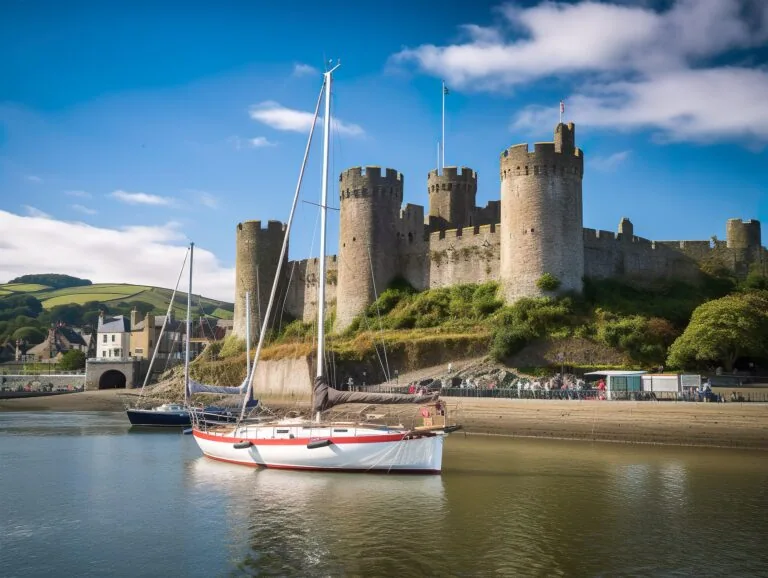
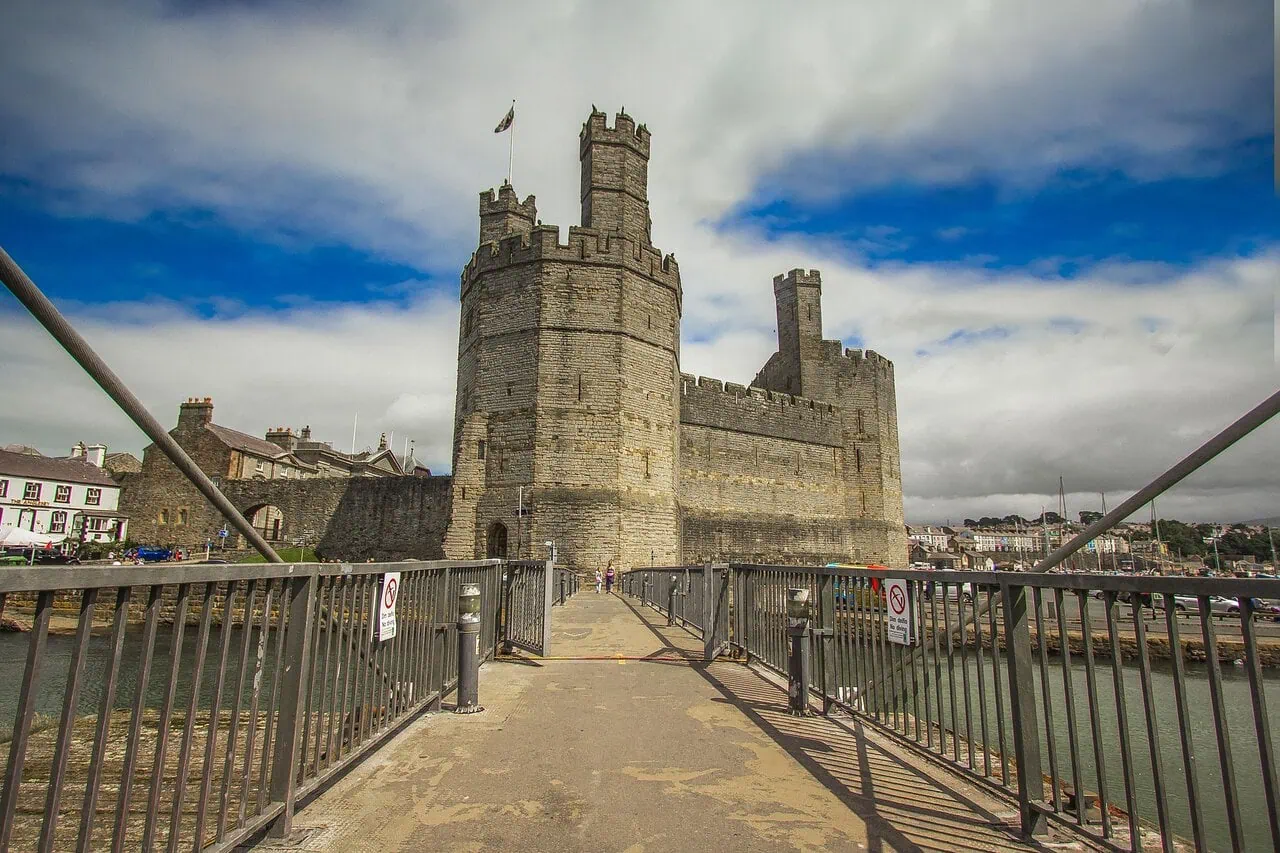
Caernarfon Castle is the dominant landmark in the town, a vast fortress begun by Edward I in 1283 as the ceremonial and administrative capital of his new principality in North Wales. Its polygonal towers and banded stonework were deliberately modelled on the walls of Constantinople, setting it apart from the more conventional round towers of Conwy and Harlech.
That design makes it arguably the most architecturally ambitious of the four castles Edward built in Gwynedd, and it remains remarkably intact considering it’s over seven centuries old. Visitors can climb several of the towers via spiral stone staircases, including the Eagle Tower, for wide views over the town walls and the Menai Strait.
The castle is one of four sites that together form the Castles and Town Walls of King Edward in Gwynedd UNESCO World Heritage Site, alongside Conwy, Beaumaris and Harlech. It’s also famous as the setting for the investiture of Charles as Prince of Wales in July 1969, staged around a purpose-built dais still visible in the inner ward today.
Inside, exhibitions on the castle’s construction and its role in Welsh history are spread across several towers, giving good context before or after climbing to the battlements. Allow around 1.5 to 2.5 hours for a proper visit, more if you want to see every tower in full.
Admission for the 2026 summer season (1 June–31 August) starts from £15.60 (€17.94/$19.81) for an adult, with a child or junior ticket priced at £10.90 (€12.54/$13.84). Prices drop slightly from 1 September, and opening hours vary seasonally from 9:30am–6pm in July and August down to 10am–4pm over winter, with closures on 24–26 December and 1 January.
Booking online is worth doing during the busier summer months, since it avoids queuing at the gate on peak days. If you’re building a wider North Wales itinerary, it’s well worth pairing this visit with our Conwy Castle guide, which covers Caernarfon’s UNESCO sibling in far more depth, including its tower-by-tower layout and current admission prices.
Walk Caernarfon’s Town Walls
Caernarfon’s town walls were raised alongside the castle in the 1280s and still enclose the entire medieval town, punctuated by eight towers and two twin-towered gates. Built using the same defensive logic as Conwy’s walls just a few years later, they form one continuous circuit around the old town rather than a series of disconnected fortifications.
In character they’re comparable to Conwy’s walls, built by the same king in the same decade, though Caernarfon’s circuit is shorter and hugs the waterfront rather than climbing a hillside. The two main gatehouses, Porth Mawr and Porth yr Aur, still control the principal routes into the old town much as they did in the thirteenth century.
Entry to the walls is free, and they can be viewed and walked around externally all year during daylight hours. Unlike Conwy, walking along the top of the walls isn’t currently possible for safety reasons, so most of the experience here is admiring the stonework from street level.
The key to Porth Mawr Tower can be borrowed from a nearby shop on selected days between March and October, giving a closer look inside one of the gatehouses. It’s a small extra worth asking about locally rather than something to plan a special trip around.
A full circuit on foot takes around 20 to 40 minutes, and it combines naturally with a walk along the harbour or a stop on the Maes. Photographers in particular should aim for late afternoon light, when the stonework takes on a warm gold colour against the water.
See hotel options and places to stay for your trip.
Browse hotelsBrowse apartments, holiday homes and self-catering stays.
View rentalsCompare hotel deals from multiple booking sites in one search.
Compare pricesStep Inside St Mary’s Church
Tucked inside the north-west corner of the town walls, St Mary’s Church was built in the early 14th century as a chapel of ease for soldiers garrisoned in Edward I’s newly walled town. Its bell tower is built directly into the medieval fortifications, one of the few points where church and castle-era defences meet.
The result is a small, atmospheric building that feels more like part of the walls than a structure standing beside them. Rounded-arch windows and plain stonework give it a defensive, workaday character rather than the grandeur of a cathedral.
Inside, the church holds a simple medieval interior with later memorials and stained glass added over centuries of parish life. It remains an active place of worship rather than a museum piece, so the interior can vary by service times.
St Mary’s is one of the few buildings inside the walls that dates from the same building campaign as the castle itself. That makes it a useful stop for picturing what the town looked like in its first decades as an English garrison outpost.
Entry is free, though opening hours are limited and it’s sometimes closed outside services, so treat a look inside as a bonus rather than a certainty. The exterior and bell tower can be appreciated from Church Street at any time.
It sits only a couple of minutes’ walk from the castle gatehouse, making it an easy short stop on a walk around the town walls. Photographers should look for the angle where the tower and the walls line up together.
Explore Victoria Dock and the Harbour
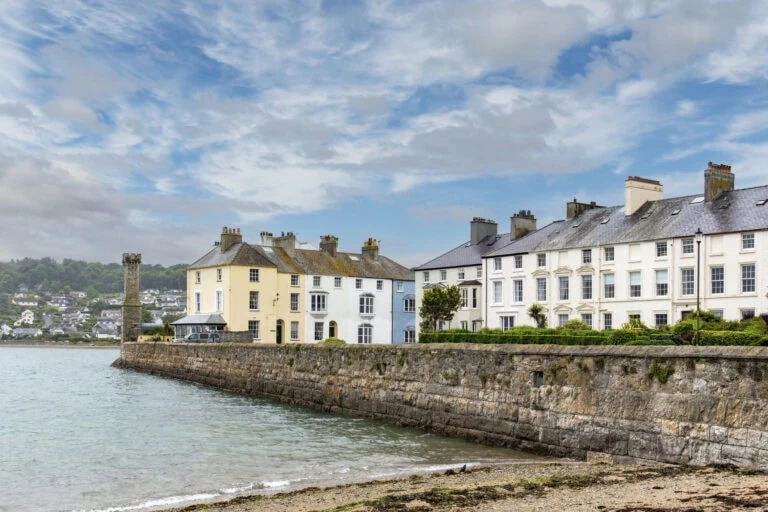
Victoria Dock sits just outside the town walls on the Menai Strait, built in the Victorian era to export slate from the Dinorwic quarries. It’s now home to a marina of pleasure boats rather than working cargo ships, though the old dock walls and cranes still hint at its industrial past.
A walk along the waterfront gives sweeping views across the strait towards Anglesey, with the castle’s turrets rising directly behind. It’s one of the best spots in Caernarfon to get the castle in a single photograph, especially with boats in the foreground.
The dock and quayside are free to explore and make an easy, flat walk to add onto a castle visit, with a handful of cafés and pubs overlooking the water. Benches along the harbourside make a good place to stop for a coffee and watch the boats come and go.
It’s also a good spot to watch the tide race through the narrows beneath the castle walls, a genuinely fast-moving current that’s worth watching for a few minutes if you’re passing. Occasional boat trips run along the strait in season, giving a different view of the castle from the water.
Allow 30 to 60 minutes to walk the full length of the dock and back, longer if you stop for food or a drink. It sits close enough to both the castle and the Maes to fold easily into the rest of a day in town.
Catch a Show at Galeri Caernarfon
Galeri Caernarfon is an arts and enterprise centre built into a converted slate-era warehouse at Doc Victoria, a few minutes from the castle. It combines a cinema, a theatre and performance space, a gallery, and a café-bar under one roof, alongside space for small creative businesses.
The cinema shows a mix of new releases and independent films, while the main auditorium hosts touring theatre, comedy, live music and Welsh-language productions through the year. It’s one of the few places in Caernarfon geared towards evening entertainment rather than daytime sightseeing.
The building is worth a look even without booking anything, with large glass frontages looking straight out over the marina and its yachts. Exhibitions in the gallery space change regularly and are usually free to walk around.
Entry to the building and café-bar is free, and browsing the programme costs nothing even without buying a ticket for a show. Film and theatre tickets are priced individually, typically in line with a small regional cinema elsewhere in Wales.
Allow 30 minutes to look around the foyer and gallery, or half a day if catching a film or show and eating at the café-bar beforehand. It pairs naturally with a walk along Victoria Dock, since it sits right on the same waterfront.
Checking the programme in advance is worth it if you want to catch something specific, since screenings and performances don’t run every day. It’s a good option for an evening in Caernarfon once the castle and walls have closed.
Ride the Welsh Highland Railway
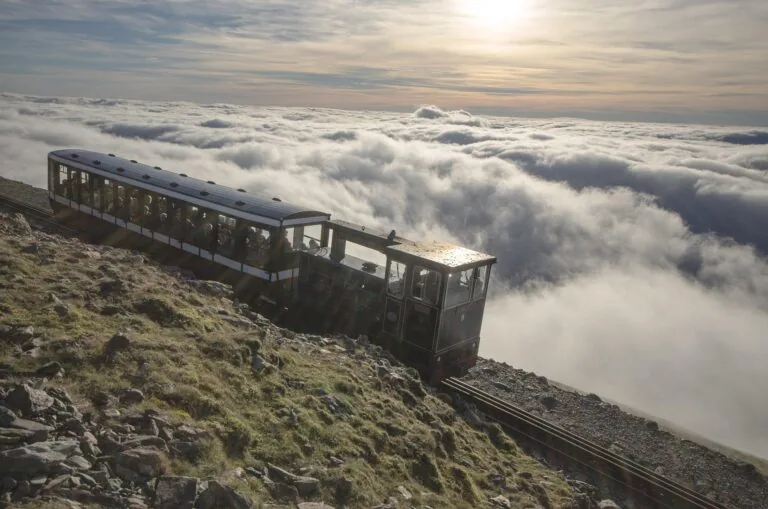
The Welsh Highland Railway is a narrow-gauge heritage line running from a terminus beside Caernarfon Castle deep into Snowdonia, following one of the most scenic stretches of track in Britain. It passes the foothills of Yr Wyddfa along the way, with views that are hard to match from a car or on foot.
Steam and heritage diesel locomotives haul vintage carriages along routes to Rhyd Ddu, Beddgelert and, on the full run, Porthmadog. It’s one of the longest heritage railways in Britain, and a genuinely different way to see Snowdonia than driving the roads that skirt the same mountains.
The best-known service, the Gelert Explorer, runs from Caernarfon to Beddgelert and back, a three-hour, 27-mile round trip that includes up to 75 minutes to explore the village. Beddgelert itself is one of the prettiest villages in Snowdonia, with stone cottages and a river running through the centre, well worth the stopover.
A return adult ticket costs from £58.50 (€67.28/$74.30), with children aged 3 to 15 charged a flat £5.00 (€5.75/$6.35) and under-3s travelling free. Shorter hops to Rhyd Ddu and the full run to Porthmadog are priced separately and worth checking on the day you plan to book.
Popular services like the Gelert Explorer can sell out during school holidays, so it’s worth reserving seats a few days ahead rather than turning up on the day. Trains are step-free at the Caernarfon terminus, which makes boarding straightforward for pushchairs and wheelchairs.
For walkers heading up the mountain itself, our Visiting Snowdon guide covers routes and practicalities in full, while our Welsh Trains Guide explains how the line connects with the wider Welsh rail network at Porthmadog. Between the two, it’s easy to plan a full day that starts on the train and ends on the mountain, or the other way round.
Cycle or Walk the Lôn Eifion Trail
The Lôn Eifion trail follows a dismantled railway line for around 12.5 miles between Caernarfon and the village of Bryncir, a flat, traffic-free route through open Llŷn Peninsula countryside. It’s part of the National Cycle Network and starts close to the castle and the Welsh Highland Railway terminus.
The surface is smooth and well maintained for most of its length, running through farmland, patches of woodland and open fields with views towards the mountains of Eryri. It’s an easy ride or walk rather than a technical one, with no significant climbs along the way.
Cyclists can ride the full route out and back, or turn around at any point for a shorter loop suited to families with younger children. Walkers tend to use shorter stretches near Caernarfon rather than covering the whole distance in one go.
It’s a genuinely different way to see the countryside around Caernarfon compared with the town’s medieval sights, and it’s free to use year-round. Bike hire is available in Caernarfon itself for anyone without their own wheels.
Allow an hour or two for a there-and-back ride from town, or a full half-day for the whole route to Bryncir and back. It’s best avoided at the height of summer heat given the lack of shade over the open sections.
The trail’s starting point near the castle makes it an easy add-on for anyone with a spare hour and a bike, without needing to drive anywhere first. It also connects loosely with Lôn Las Menai, a shorter waterside route towards the strait.
Discover Segontium Roman Fort
On the edge of town, Segontium Roman Fort marks the site of a Roman garrison established around AD 77 to hold the recently conquered northwest of Wales. It predates the medieval castle by more than a thousand years, making it one of the oldest visible sites in Caernarfon.
Excavated foundations of barracks, granaries and the commandant’s house give a genuine sense of the site’s scale, even though most walls now survive only at ground level. Information boards around the site help make sense of the layout for anyone without a background in Roman archaeology.
The outdoor site is free to visit and open year-round during daylight hours, cared for by Cadw as part of the same guardianship that looks after the castle and walls. It’s a quiet, open site, usually far less crowded than the castle itself, which suits anyone wanting a slower, more reflective stop.
Cadw also runs seasonal guided tours, bookable in advance, with prices starting from £12.00 (€13.80/$15.24) for an adult, giving a more detailed look at the fort between May and August. Tickets for these tours aren’t sold on arrival, so it’s worth reserving a place ahead of time if you want the closer look.
Allow 30 to 60 minutes for a self-guided visit, longer if you join one of the tours. It’s roughly a 15-minute walk from the castle, making it an easy add-on for anyone with a full day in Caernarfon.
Search routes and flight options for your journey.
Search flightsBrowse Airalo eSIM options for convenient travel data.
Check eSIMsBook a private airport transfer in advance and have your ride planned before you arrive.
Check transfersVisit Llanbeblig, Caernarfon’s Oldest Church
St Peblig’s Church at Llanbeblig, just beyond Segontium, is traditionally reckoned to be the oldest Christian site in Caernarfon, with roots said to date back to the 5th century. Local legend links its founding to Peblig, a son of the Roman emperor Magnus Maximus, who ruled from the fort at Segontium.
Long before the current building went up, the site overlapped with the edge of the Roman settlement, and the churchyard is thought to contain burials connected to the garrison that once occupied Segontium. That’s a direct link between Caernarfon’s Roman past and its medieval town.
The church passed to Aberconwy Abbey in the 13th century, granted by Llywelyn the Last, and most of what visitors see today dates from a 14th-century rebuilding. Later renovations have added to the fabric, but the core layout still reflects its medieval origins.
Inside, look out for older memorials and monuments that have survived successive rebuilds, giving a genuine sense of continuous use stretching back centuries. It’s a quieter, less-visited stop than the castle or Segontium, which suits a slower pace.
Entry is free, though as an active parish church it’s best visited outside service times, and opening can be limited to certain days. The churchyard itself can usually be walked around even when the building is locked.
It sits only a few minutes’ walk from Segontium Roman Fort, making the two a natural pairing for anyone interested in Caernarfon’s history before the castle existed. Together they cover more than a thousand years of the site’s story in under an hour.
Get Hands-On at Airworld Aviation Museum
Airworld Aviation Museum sits on the edge of the working airfield at Caernarfon Airport, a few miles south of town near Dinas Dinlle. Unlike most aviation museums, it lets visitors climb into the cockpits of many historic aircraft on display rather than just viewing them from behind a rope.
The collection includes a mix of military and civilian aircraft, along with engines, instruments and memorabilia charting the history of flight in North Wales. Volunteers on site are often happy to talk through individual exhibits, adding detail display boards alone don’t cover.
Its setting on an active general aviation airfield adds a genuine sense of atmosphere a purpose-built museum elsewhere wouldn’t have, with light aircraft occasionally taking off or landing nearby. The airport café also has views out towards Snowdonia and the coast.
Admission starts from £7.00 (€8.05/$8.89) for an adult, with children priced from £5.00 (€5.75/$6.35) and family tickets available. There’s no need to book ahead, since entry is pay-on-arrival.
Allow around an hour to an hour and a half to look around properly, longer with aviation-minded children keen to explore every cockpit on offer. Note that the museum doesn’t have its own toilets, with the nearest facilities in the airport café across the car park.
It’s best reached by car, since it sits outside the compact town centre where most of Caernarfon’s other sights are clustered. Combining it with Dinas Dinlle beach, a short drive further along the coast, makes for an easy half-day out beyond the walls.
Try Watersports at Plas Menai
Plas Menai is Wales’s national outdoor centre for watersports, set directly on the Menai Strait at Griffiths Crossing, a short drive from Caernarfon town centre. It offers RYA-accredited courses and taster sessions in sailing, windsurfing, sea kayaking, stand-up paddleboarding and powerboating.
The centre suits everyone from complete beginners trying a sport for the first time to experienced sailors working towards formal qualifications. Discovery sessions are aimed at newcomers, giving a supervised introduction without needing your own equipment or experience.
Family sessions are available for children from around age eight upwards, a good option for an active day that’s genuinely different from the town’s historic sights. The sheltered water of the strait gives a relatively calm training ground compared with the open coastline nearby.
Beyond the water, the site has a restaurant and bar, a small gym and swimming facilities, and on-site accommodation for anyone booking a multi-day course. It’s a working training centre first and a tourist attraction second, so the atmosphere is more purposeful than polished.
Pricing depends heavily on the activity and session length, from a short taster session up to a multi-day residential course, so it’s worth checking current rates directly with the centre before planning a visit. Booking ahead is strongly advised, since sessions run to fixed group sizes.
Allow at least half a day for a single taster session once changing and safety briefings are factored in. It’s a worthwhile detour for anyone building an active few days around Caernarfon rather than sticking purely to castles and museums.
Compare hostels and budget-friendly places to stay.
Browse hostelsGet fast compensation payouts, eligible lounge benefits and expert help when flights go wrong.
See AirHelp+ benefitsArriving before check-in or leaving later? Store your luggage and enjoy the extra time hands-free.
Store your bagsBrowse the Maes and Caernarfon’s Independent Shops
The Maes is Caernarfon’s main square, sitting just outside the castle walls and forming the natural hub of the town. It’s lined with cafés and gives direct views straight up at the castle gatehouse, making it a good spot to get your bearings.
It’s the obvious place to start or finish a visit, and often hosts markets and events through the summer. Market days in particular bring extra stalls and a livelier atmosphere than a normal weekday visit.
Beyond the Maes, the streets inside and just outside the walls hold a good spread of independent shops and cafés, from Welsh craft and outdoor gear specialists to family-run bakeries. It’s a different feel from the chain stores found in bigger towns nearby, and worth a browse even if you’re not planning to buy anything.
It’s a pleasant way to fill half an hour between the bigger sights, particularly if the weather turns and you want somewhere under cover. Several cafés around the square do a decent lunch, useful if you’re timing a visit around the castle or a train departure.
Allow 30 to 60 minutes to wander the square and surrounding streets properly. It sits at the centre of everything else in Caernarfon, so it’s easy to dip in and out of throughout the day rather than treating it as a single stop.
Walk Along the Menai Strait from Caernarfon
Caernarfon’s position on the Menai Strait means you don’t have to travel far from the castle to swap medieval streets for a waterside walk. Paths continue beyond the harbour and historic centre, providing views across the narrow channel towards Anglesey and back towards the castle.
The waterfront is particularly attractive around Victoria Dock, but continuing beyond the marina takes you away from the busiest part of town. The Menai Strait remains alongside you, with boats, tidal currents and the mountains of North Wales providing an ever-changing backdrop.
Caernarfon also sits on the Wales Coast Path, so stronger walkers can use the town as the beginning or end of a much longer route. Heading northeast eventually takes you towards Bangor and the bridges across to Anglesey, while the path continues south and west around the coastline beyond Caernarfon.
You certainly don’t need to attempt an entire long-distance section. A 30 to 60-minute waterfront walk is enough to see a different side of Caernarfon and works particularly well after several hours exploring the castle and narrow streets within the walls.
Walking is free, and there’s no timetable or admission time to worry about, making this useful early in the morning or towards the end of the day when the main historic attractions have closed.
If you want to turn it into a proper hike, our Wales Coast Path guide covers the North Wales sections in much more detail, including the route along the Menai Strait. Otherwise, simply walk until you’ve had enough and return to the castle and harbour.
Visit Dinas Dinlle Beach and Hillfort
Around six miles southwest of Caernarfon, Dinas Dinlle combines a long beach with one of the most dramatically positioned ancient sites on this part of the North Wales coast. It’s particularly easy to combine with Airworld Aviation Museum, which sits at nearby Caernarfon Airport.
The beach stretches along the coast with views across Caernarfon Bay and towards the Llŷn Peninsula, while the mountains of Eryri rise behind you. On a clear day, the combination of sea and mountains makes this one of the most scenic coastal stops within easy reach of Caernarfon.
Above the beach is Dinas Dinlle hillfort, an Iron Age fortified settlement occupying the top of the coastal hill. Its defensive banks and ditches can still be identified, although coastal erosion has gradually claimed part of the original site.
The elevated position explains why the location was chosen. From the hillfort there are extensive views across the surrounding coastline and inland towards the mountains, making it worthwhile even if prehistoric archaeology isn’t normally one of your interests.
Access to the beach and hillfort is free, so Dinas Dinlle works well as a low-cost addition to a day dominated by paid attractions such as Caernarfon Castle or the Welsh Highland Railway.
Allow around one to two hours for the beach and hillfort, longer during good weather if you want to spend time beside the sea. Combining Dinas Dinlle and Airworld creates an easy half-day excursion from Caernarfon without requiring a long drive.

Explore Parc Glynllifon
A short journey south of Caernarfon brings you to Parc Glynllifon, a historic country park offering woodland walks, gardens and open green space away from the busier attractions around the castle.
The estate developed around Glynllifon mansion, historically associated with the Newborough family, and the surrounding parkland contains traces of its former life as a substantial country estate. Paths lead through woodland and landscaped grounds rather than following a single prescribed visitor route.
One of the main reasons to visit is simply to walk and explore. The park contains mature trees, streams, historic structures and quieter corners that feel very different from Caernarfon’s densely built medieval centre.
It’s particularly useful for families, as there’s more room for children to explore than at many of the area’s historic attractions. It also makes a good change of pace after a morning spent climbing castle towers or travelling on the Welsh Highland Railway.
Allow around one to two hours for a relaxed walk, although it’s easy to stay longer if the weather is good. Check current access, parking and opening arrangements before travelling, particularly if you want to visit any facilities or buildings rather than simply explore the parkland.
Parc Glynllifon combines naturally with Dinas Dinlle and Airworld Aviation Museum, allowing the three to form a varied day outside Caernarfon. You can then return to the town for the castle, harbour or an evening meal within the walls.
Experience Caernarfon’s Welsh Language and Culture
One of the things that distinguishes Caernarfon from many other visitor towns in Britain isn’t a conventional attraction at all. Welsh is part of everyday life here, and visitors are likely to hear it being spoken naturally in shops, cafés and on the streets.
That makes Caernarfon an interesting place to experience contemporary Welsh culture rather than viewing Welsh history exclusively through castles and museums. The language isn’t being presented for tourists; it’s simply part of how the town functions.
You’ll see Welsh throughout the town on signs, menus, posters and local businesses, often alongside English. There’s no need to speak Welsh yourself, but learning simple expressions such as “diolch” (thank you) is an easy way to engage with the language during your visit.
The cultural side of Caernarfon is also visible at Galeri Caernarfon, where Welsh-language music, theatre and other performances form part of the programme. Independent shops around the Maes and within the walls are another good place to find Welsh books, crafts and locally produced goods.
This living culture provides an interesting contrast with Caernarfon Castle. The fortress represents Edward I’s conquest and attempts to control medieval Gwynedd, while the town surrounding it remains somewhere where the Welsh language and identity are highly visible centuries later.
Don’t treat this as something requiring a separate hour in your itinerary. Instead, pay attention to the town around you while exploring the Maes, harbour and streets within the walls. It’s an important part of understanding modern Caernarfon rather than simply seeing it as a collection of historic monuments.
Best Things to Do in Caernarfon With Children
Caernarfon works well with children, who usually enjoy climbing the castle’s towers and battlements and spotting boats along Victoria Dock. The mix of real history and physical exploring tends to hold younger visitors’ attention far longer than a typical museum stop.
The Welsh Highland Railway is a reliable hit too, with steam engines and open carriages giving a proper day out rather than just a train ride. Even children who aren’t especially interested in trains tend to enjoy the mountain scenery and the novelty of a steam locomotive up close.
Segontium Roman Fort’s open grounds give space to run around away from the crowds inside the walls, and the site’s low walls are easy for children to explore safely. It’s a good option for burning off energy between more structured stops.
The flat, level paths around the Maes and harbour suit pushchairs well, and there are enough cafés nearby for a break when needed. Toilets and baby-change facilities are available around the town centre, including near the castle and the Maes.
Most of the town’s attractions sit within a 10-minute walk of each other, so a full family day is easy to plan without a car. That makes Caernarfon a relatively low-stress destination for families compared with sites that need a lot of driving between stops.
Best Free Things to Do in Caernarfon
Caernarfon is generous with free attractions, and it’s possible to spend a full morning in the town without paying a single admission fee. Walking around the outside of the town walls, exploring Victoria Dock and the harbour, wandering the Maes, and visiting the outdoor grounds of Segontium Roman Fort all cost nothing.
The castle’s exterior and gatehouse views are free even without a ticket, and the walk around the outside of the walls gives some of the best photo spots in town. Even a short stroll along the walls takes in most of the town’s medieval character without needing to go inside anything.
That’s enough to fill a satisfying half day, making Caernarfon a genuinely good-value stop on the North Wales coast. It suits anyone travelling on a tighter budget, or simply looking to balance a paid castle visit with a few free hours.
Free attractions combine easily with a stop at one of the Maes’s cafés, which don’t require a purchase to sit and admire the view. Between the walls, the harbour and the fort, there’s enough to genuinely fill a day even without setting foot inside a ticketed attraction.
Most of these free spots sit close together, so it’s easy to string them into a single loop on foot. Starting at the Maes and finishing along the harbour makes a natural, flat route that takes in the best of the town’s free sights.
How Long Do You Need in Caernarfon?
A focused visit to the castle, town walls and harbour can be done in half a day, which suits anyone combining Caernarfon with Anglesey or the rest of the North Wales coast. It’s enough time to see the main sights properly without feeling rushed.
With a full day, you can add Segontium Roman Fort, a ride on the Welsh Highland Railway and time browsing the Maes. That combination gives a genuinely varied day, mixing medieval history, Roman archaeology and a scenic train ride into Snowdonia.
Caernarfon also works well as a base for a night or two, particularly for anyone planning to explore Snowdonia by train rather than rushing between stops on a single day trip. Staying overnight also means you can catch the castle and walls in the early morning or evening light, before the day-trip crowds arrive.
Anyone short on time can still see the essentials, the castle exterior, a stretch of the walls and the harbour, in as little as two hours. It’s a flexible town that rewards a longer stay without punishing a shorter one.
For a slower pace, spread the castle, walls and harbour across a morning and add the Welsh Highland Railway or Segontium in the afternoon. That avoids trying to pack everything into a single rushed loop, and leaves time to actually enjoy each stop.
Getting to Caernarfon
Caernarfon isn’t served by a mainline railway station of its own beyond the heritage Welsh Highland Railway terminus, so most visitors arrive by road or bus rather than the main line. That makes it a slightly different logistical case from Conwy or Bangor, both of which sit directly on the coastal railway.
Regular buses connect the town with Bangor, which sits on the North Wales Coast Line, and with Llanberis and the rest of Snowdonia. Journey times from Bangor are short, usually well under an hour, making it an easy onward hop for anyone arriving by train.
Drivers can use several pay-and-display car parks around the town centre and near the castle, since the historic core itself has narrow, largely pedestrianised streets. It’s worth parking outside the walls rather than trying to drive into the centre itself.
The walk from most car parks into the centre takes only a few minutes, and the whole old town is compact enough to cover entirely on foot once you’ve arrived. That makes a car genuinely optional once you’re parked, rather than something you need to keep moving between sights.
Caernarfon fits naturally into a wider Wales itinerary; see our full Wales Travel Guide for how it pairs with Snowdonia, the coast and the rest of North Wales. Combining it with a night in Snowdonia or a day on Anglesey makes for an easy, low-stress few days without much driving.


Rupert’s Handy Travel Tips
Heading to Caernarfon? Here are a few useful tips to help you make the most of your visit:
- Book the castle in advance in summer: Caernarfon Castle gets busy on peak summer days, and booking online avoids queuing at the gate.
- Book Welsh Highland Railway trains ahead: Popular services like the Gelert Explorer can sell out during school holidays, so reserve seats before you travel.
- Ask about Cadw’s £1 ticket: Visitors on Universal Credit or certain other benefits can get castle entry for just £1.00 (€1.15/$1.27), so it’s worth asking when you book.
- Book Segontium’s guided tours online: Tickets for the seasonal guided tours aren’t sold on arrival, so reserve a place in advance if you want the closer look at the fort.
- Park outside the walls: The historic centre’s streets are narrow and largely pedestrianised, so use one of the pay-and-display car parks nearby rather than trying to drive in.
Want to meet the reindeer behind our travel tips? Find out more in our page Who is Rupert?.
Frequently Asked Questions
Is Caernarfon worth visiting?
Yes. Caernarfon combines a UNESCO World Heritage castle, medieval town walls, a working harbour on the Menai Strait and a heritage steam railway into Snowdonia, all within a compact, walkable town centre, making it one of the best-value stops in North Wales.
Is Caernarfon Castle part of a UNESCO World Heritage Site?
Yes. It’s one of four sites that together make up the Castles and Town Walls of King Edward in Gwynedd UNESCO World Heritage Site, alongside Conwy Castle, Beaumaris Castle and Harlech Castle.
What happened at Caernarfon Castle in 1969?
Caernarfon Castle hosted the investiture of Charles as Prince of Wales in July 1969, a ceremony held in the inner ward and broadcast to hundreds of millions of viewers worldwide.
How much does it cost to visit Caernarfon Castle?
Summer 2026 admission (1 June–31 August) is £15.60 (€17.94/$19.81) for an adult, with lower prices for juniors, students and seniors, and a small reduction from 1 September.
Can you visit Segontium Roman Fort for free?
Yes. The outdoor site is free to visit year-round, though Cadw’s seasonal guided tours between May and August are ticketed and cost £12.00 (€13.80/$15.24) for an adult.
How do you get from Caernarfon to Snowdon?
The Welsh Highland Railway runs from Caernarfon towards Snowdonia, stopping close to routes up Yr Wyddfa, and regular buses also connect the town with Llanberis and other trailheads.
Further Reading & Related Guides
Caernarfon Castle is one quarter of a single UNESCO World Heritage Site, so if you’re building a wider North Wales itinerary it’s worth pairing this visit with our Conwy Castle guide, which covers its sister fortress in full detail, from its eight towers to current admission prices.
For anyone continuing into the mountains from Caernarfon, our Visiting Snowdon guide covers routes up Yr Wyddfa in full, while our Welsh Trains Guide explains how the Welsh Highland Railway connects with the country’s heritage and main lines.
For the bigger picture of what else North Wales and the rest of the country have to offer, our Wales Travel Guide brings together the national parks, coastline and castles that pair naturally with a visit to Caernarfon.