Reviewed by our editorial team Updated
Getting from Geneva to Chamonix: What You Need to Know
Travelling from Geneva Airport to Chamonix is one of the most popular airport-to-mountain routes in Europe, used year-round by travellers heading into the Alps. In winter, the route is dominated by ski travellers, while in summer it serves hikers, climbers, and visitors heading toward Mont Blanc.
The key advantage of this journey is simplicity. Unlike many Alpine routes, you are travelling a relatively short distance, typically reaching Chamonix in around 1 hour 15 minutes to 1 hour 30 minutes by road. This makes it one of the fastest ways to go from a major international airport directly into a high-mountain resort.
Most journeys begin directly at Geneva Airport, not in the city centre. This matters, because many services are specifically designed for arriving passengers, with direct departures, luggage handling, and minimal walking between connections. If you plan correctly, you can move from arrivals to your transfer with very little friction.
You have several options, including direct bus transfers, trains with a change, private transfers, and car hire. While all are viable, they are not equal in terms of speed, convenience, and effort, especially if you are travelling with luggage or arriving after a flight.
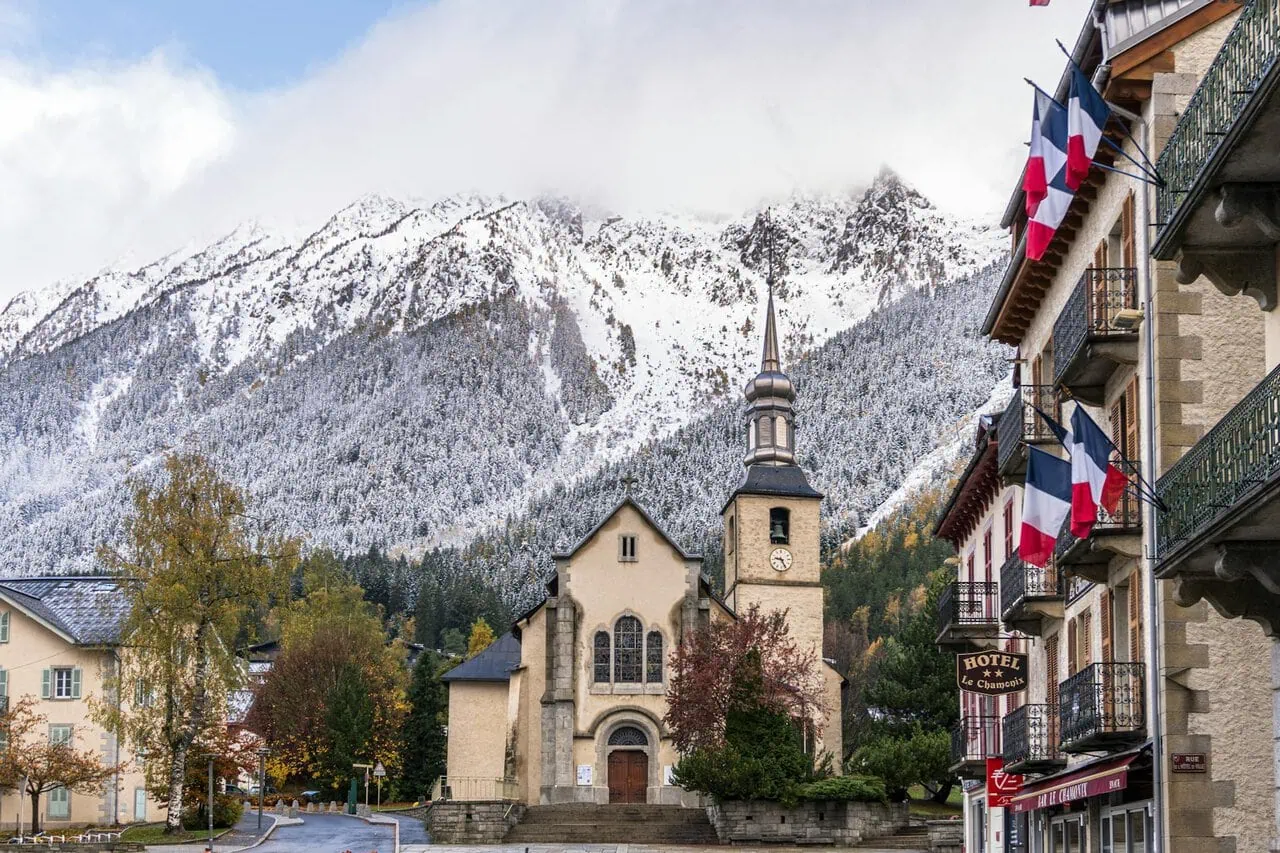
The route itself crosses from Switzerland into France and follows the valley toward Chamonix. As you approach the resort, the scenery becomes increasingly dramatic, with steep alpine walls, forested slopes, and the Mont Blanc massif dominating the skyline.
| Option | Time | Cost | Best For |
|---|---|---|---|
| Bus Transfer | 1h 15–30 | From €14 (£12 / $16) | Most travellers |
| Train | 2–2.5h | Medium | Scenic journeys |
| Private Transfer / Taxi | 1h–1h 20 | High | Comfort, groups |
| Driving | 1h–1h 20 | Medium | Flexibility |
Best Airport for Chamonix
Many first-time visitors search for Chamonix Airport or Chamonix Mont Blanc Airport, but there is no commercial airport located in Chamonix itself. Instead, the vast majority of travellers fly into Geneva Airport (GVA) in neighbouring Switzerland before continuing by road into France.
The reason is simple. Geneva Airport to Chamonix is one of the quickest airport-to-mountain resort journeys in Europe, with transfer times typically ranging from 1 hour 15 minutes to 1 hour 30 minutes. This makes Geneva the most practical and best-connected airport for Chamonix, with flights arriving from across Europe, North America, the Middle East and beyond.
Other airports can be used, including Lyon-Saint Exupéry Airport, Turin Airport, and Chambéry Airport, but these generally involve longer transfer times and fewer direct transfer services. For most visitors heading to Chamonix-Mont-Blanc, Geneva remains the clear first choice.
| Airport | Approximate Distance to Chamonix | Typical Transfer Time |
|---|---|---|
| Geneva Airport (GVA) | 100 km | 1h 15m–1h 30m |
| Turin Airport | 170 km | 2h–2h 30m |
| Lyon Airport | 220 km | 2h 30m–3h |
| Chambéry Airport | 145 km | 1h 45m–2h |
For travellers searching for the best airport for Chamonix, Geneva Airport is almost always the recommended option due to its combination of frequent flights, competitive fares, and fast onward transfers into the valley.
Best for two or three nights. The widest choice of rooms, with filters for free cancellation and included breakfast.
View staysBest for families, or any stay past about four nights. A kitchen and a washing machine start paying for themselves.
Browse rentalsBest for double-checking. Runs the same search across several booking sites so you are not leaving money behind.
Compare pricesBus Transfers from Geneva to Chamonix: Most Popular Option
For most travellers, a direct bus transfer from Geneva Airport to Chamonix is the simplest and most reliable choice.
These services are built specifically for this route, with frequent departures throughout the day and no need to change vehicles or navigate stations. Journey times are typically 1 hour 15 minutes to 1 hour 30 minutes, depending on traffic and drop-off locations within the Chamonix valley.
The main advantage is how easy the process is. After landing, you head to the designated transfer area, load your luggage, and travel directly to your destination. There is no need to coordinate connections or move between transport systems, which makes a noticeable difference after a flight.
Coaches are generally modern and well-equipped, with dedicated luggage storage and space for ski equipment in winter. Many services are timed around common flight arrivals, which reduces waiting time and helps keep the journey smooth.
Multiple operators run this route, including easyBus and Alpybus, which keeps pricing competitive; easyBus fares for the 75-minute journey start from around £14.99 ($19 / €17) one way when booked in advance, though the exact price depends on how far ahead you book. Booking in advance is recommended, particularly during winter ski season and summer peak periods, when the most convenient departure times can fill up quickly.
For most travellers, this option delivers the best balance of speed, cost, and simplicity, which is why it is the default recommendation.

Travel by Bus to Geneva with Busbud
For bus and coach journeys involving Geneva, Busbud gives you a single place to search services from different operators.
It is particularly useful for budget travel, intercity routes and destinations where buses are the most practical public transport option.
Terravision Coach Service from Geneva Airport to Chamonix
Travellers heading for the French Alps can use the Terravision airport coach service between Geneva Airport and Chamonix, one of the most popular mountain transfer routes in the company’s network. The service is designed specifically for passengers travelling to the famous Alpine resort and provides a convenient alternative to private transfers.
The coach journey takes approximately 75 minutes, connecting Geneva Airport directly with Chamonix in the heart of the French Alps. The route is particularly popular during the ski season but is also heavily used by hikers, climbers and summer visitors exploring the Mont Blanc region.
Fares start from around €14 (£12 / $16) one way, or €29 (£25 / $32) return, on Terravision’s own site. The coaches provide luggage storage suitable for travellers carrying ski equipment, suitcases and outdoor gear. Advance booking is recommended during peak winter periods when demand for transfers to Chamonix can be especially high.
For visitors flying into Geneva and continuing onwards to the mountains, Terravision offers one of the most affordable and straightforward transfer options available.
Find Terravision Transfers for Geneva
Looking for an airport coach into Geneva? Terravision connects selected European airports with city destinations using dedicated transfer services.
Checking the route in advance can help you compare the coach against local buses, trains or taxi options before deciding how to reach the city.
Train from Geneva to Chamonix: Scenic Route via Saint-Gervais
Travelling by train from Geneva to Chamonix is possible, but it is not a direct or straightforward journey, and that is the key trade-off to understand.
There is no direct train connection, so all routes require at least one change. The most common and reliable route runs from Geneva to Saint-Gervais-les-Bains Le Fayet, followed by a connecting mountain train into Chamonix.
The first leg is typically operated by SNCF regional trains (TER), running from either Geneva Cornavin station or, less conveniently, from connections via the airport. This part of the journey takes around 1 hour to 1 hour 20 minutes, depending on the service.
At Saint-Gervais-les-Bains Le Fayet, you transfer to the Mont Blanc Express, a narrow-gauge mountain railway that climbs into the Chamonix valley. This second leg takes around 45 minutes to 1 hour, passing through alpine villages, forested slopes, and elevated valley sections with increasingly dramatic views.
Total journey time is usually around 2 hours 25 minutes to 3 hours, but this depends heavily on connection times, which are not always perfectly aligned. A missed connection can add significant delay, especially outside peak hours.
One of the biggest practical drawbacks is logistics. If you are arriving at Geneva Airport, you first need to transfer into the city or connect onto the rail network, adding an extra step before the main journey even begins. Managing luggage, ski equipment, and platform changes can make the process feel more complex than it should be for such a short distance.
Ticketing is relatively straightforward but not always intuitive. You can book through SNCF Connect, Trainline, or other rail platforms, and tickets are usually priced in the range of €30 to €60 (£26–£52 / $33–$65), depending on timing and availability. Some tickets cover the full journey, while others may require separate bookings for each leg.
Where the train does stand out is the experience. The Mont Blanc Express section in particular is one of the most scenic rail routes in the region, offering views that you simply do not get from the road. For travellers who enjoy rail journeys, this part of the trip can be a highlight in itself.
However, for most visitors, especially those arriving after a flight, the extra time, required changes, and added complexity make the train less practical than a direct transfer. It works best for travellers who are not in a rush, are travelling light, and actively want a scenic rail experience rather than the fastest route.
Travel by Train to Geneva with Omio
For rail journeys involving Geneva, Omio gives you a single place to search available services and compare different travel options.
It can simplify planning when several train companies operate along your route, or when you want to compare rail, coach and flight connections.
Scan to open
on your phone


Private Transfers and Taxis: Fastest and Most Comfortable Option
If you want the most straightforward and comfortable journey from Geneva to Chamonix, a private transfer or taxi is the top-tier option.
These services provide door-to-door transport from Geneva Airport directly to your accommodation, removing the need to navigate stations, queues, or shared transport. Journey time is typically around 1 hour to 1 hour 20 minutes, depending on traffic and weather conditions.
The key advantage is convenience. You are met on arrival, assisted with luggage, and taken directly to your destination without any intermediate stops. This makes it particularly valuable if you are arriving late at night, travelling with children, or carrying ski equipment.
This option also works well for groups. While the overall price is higher, typically ranging from €120 to €250 per vehicle (£103–£215 / $131–$273), the cost becomes more reasonable when split between multiple travellers.
Vehicles are usually comfortable, spacious, and winter-equipped, ensuring a smooth journey even in colder conditions. This reduces stress significantly compared to navigating public transport in an unfamiliar location.
While it is not the cheapest option, it is the most predictable, efficient, and low-effort way to reach Chamonix, which is why many travellers choose it after a long journey.
Make Your Arrival in Geneva Easier
A pre-arranged Welcome Pickups transfer can take care of the journey from the airport when you arrive in Geneva.
This can be particularly handy for first-time visitors, families with luggage, and passengers arriving when public transport services are less frequent.
Want to compare Geneva transfer prices? You can also check another transfer provider before booking.
Car Hire at Geneva Airport
If you’re travelling from Geneva Airport to Chamonix, hiring a car can be an excellent option if you plan to explore more of the French Alps during your stay. While shared shuttles and private transfers provide a convenient way to reach Chamonix, having your own vehicle gives you the flexibility to visit neighbouring mountain resorts, scenic alpine passes and picturesque villages at your own pace.
Geneva Airport has a wide selection of international and local car hire companies, with rental desks located in both the Swiss and French sectors of the airport. If you’re staying in France and don’t intend to drive in Switzerland beyond leaving the airport, collecting your vehicle from the French sector can sometimes offer lower rental rates and help you avoid additional cross-border charges. It’s important to check your rental agreement carefully, as not all companies include cross-border travel or motorway vignettes as standard.
Before booking, it’s worth comparing several providers rather than choosing the first offer you see. Rental prices, insurance options, mileage limits and winter equipment can vary considerably between companies. During the ski season, make sure your vehicle is equipped with appropriate winter tyres, and if you plan to drive on mountain roads after heavy snowfall, check whether snow chains are provided or recommended.
A hire car is ideal if you want to explore destinations beyond Chamonix, including Megève, Saint-Gervais-les-Bains, Annecy, Yvoire, the Aiguille du Midi, or even continue your journey through the Alps into Italy via the Mont Blanc Tunnel. However, if you’re staying solely in Chamonix, a transfer or shuttle is often the simpler choice, as the town has excellent local buses and many attractions are within walking distance. Hiring a car is best suited to travellers planning a wider Alpine adventure rather than those visiting Chamonix alone.
Plan Your Geneva Car Hire
If a road trip or several day trips are part of your visit to Geneva, arranging car hire before arrival can make planning much simpler.
Use Discover Cars and EconomyBookings to compare available vehicles, suppliers and booking conditions for your travel dates.
Driving from Geneva to Chamonix: Flexible but Weather Dependent
Driving from Geneva to Chamonix is a straightforward and relatively quick journey, but it comes with a few important considerations, particularly in winter.
The route mainly follows the A40 motorway, often referred to as the “Autoroute Blanche”, which runs directly into the Chamonix valley. In good conditions, the journey takes around 1 hour to 1 hour 20 minutes, making it comparable to private transfers.
On paper, driving offers maximum flexibility. You can leave when you want, stop along the way, and travel directly to your accommodation, without relying on fixed schedules. This can be particularly useful if you are planning to explore the wider region or continue further into the Alps.
However, alpine conditions can change quickly. During winter, snow, ice, and heavy traffic heading toward ski resorts can significantly affect journey times. French regulations may also require winter tyres or snow chains, and checks can be enforced during adverse weather.
Border crossing between Switzerland and France is usually smooth, but traffic can build at peak times, especially on weekends during ski season. This can add unexpected delays to what is otherwise a short journey.
Parking in Chamonix is generally manageable, with a mix of public car parks and accommodation-based parking, but central areas can become busy during peak periods.
If you are confident driving in mountain conditions, it is a strong option. For many travellers, though, the added variables make transfers or buses a more predictable choice.
Best if you can move a day either way. Shows how the fare changes across the month.
Compare flightsBest for anyone whose home plan charges by the megabyte abroad. Pay a fixed price up front.
Check eSIMsBest when public transport has stopped, or when you are travelling with children and bags.
Book a transferWinter vs Summer Transfers: What Changes
The route from Geneva Airport to Chamonix operates year-round, but the experience can feel very different depending on the season.
During winter, demand increases significantly as travellers head into the Alps for skiing. Transfer services run frequently, but the most convenient departure times can fill up quickly, particularly on weekends and peak holiday periods. Traffic on the route also increases, especially toward the France–Switzerland border and as you approach the Chamonix valley, which can extend journey times beyond the typical 1 hour 15 to 1 hour 30 minutes.
Winter travel also introduces additional considerations such as snow conditions, road safety, and luggage requirements, particularly for those travelling with ski equipment. Booking in advance becomes more important, both to secure a seat and to ensure that your luggage is accommodated properly.
In summer, the journey is generally more flexible. Demand is still strong, particularly with hikers and visitors heading toward Mont Blanc, but transfers are less pressured and traffic is more predictable. Driving conditions are easier, and there is less concern about weather-related delays.
The route itself does not change, but how you plan it should. In winter, preparation and timing are key, while in summer you have more freedom to choose your transport on the day.
Travelling with Ski Equipment and Luggage
If you are travelling from Geneva Airport to Chamonix for a ski trip, understanding how your luggage is handled can make a significant difference to your journey.
Most bus transfer services are designed with ski travellers in mind and include luggage storage underneath the coach, often with space for skis and snowboards. However, policies vary between operators. Some include ski carriage in the standard ticket, while others require an additional fee or advance notification. Checking this before booking avoids issues at departure.
The train route is less practical when travelling with large luggage or ski equipment. While it is possible, the need to change trains at Saint-Gervais and move between platforms can make the journey feel more complicated, particularly if you are carrying multiple bags or travelling in a group.
With private transfers and taxis, luggage is usually the easiest part of the journey. Vehicles are typically equipped to handle larger items, and drivers assist with loading and unloading. This is one of the main reasons why direct transfers are popular with ski travellers, as they remove the need to manage equipment across multiple stages.
Even in summer, luggage can still be a factor, particularly for those travelling with hiking gear or planning longer stays. Choosing the right transport option often comes down to how much you are carrying and how easily you want to move from the airport to your accommodation.
Late Night and Early Morning Transfers
If your flight arrives at Geneva Airport late at night or very early in the morning, your transfer options become more limited, and planning ahead becomes more important.
Bus transfers operate throughout most of the day, but services are less frequent outside standard hours. Late arrivals may face longer waiting times or fewer direct options, particularly during quieter periods outside peak season.
Train travel is also less flexible at these times, as connections are limited and not always well aligned. A missed connection can result in significant delays, especially late in the evening when services become less frequent.
For these situations, private transfers and taxis are usually the most reliable option. They operate around the clock and allow you to travel directly from the airport to your accommodation without needing to wait for scheduled departures. This is particularly useful if you are arriving late, travelling with children, or carrying significant luggage.
If you are travelling outside normal hours, it is worth confirming your onward journey in advance. This avoids uncertainty on arrival and ensures that you can continue your journey without unnecessary delays.
Where Transfers Drop You in Chamonix
Most transfer services from Geneva Airport to Chamonix drop passengers close to the centre of town, typically near the main bus station or key hotel areas within the valley.
Chamonix itself is relatively compact, and many accommodation options are within walking distance of central drop-off points, particularly in the main town area. For hotels and apartments located slightly further along the valley, some transfer services offer multiple drop-off stops, while others may require a short taxi ride or local bus connection for the final part of the journey.
Private transfers provide the most direct experience, taking you door-to-door to your accommodation, which removes the need for any additional travel once you arrive. This is particularly useful if you are staying outside the centre or arriving with luggage.
Understanding where you will be dropped off helps you plan the final stage of your journey and avoid unnecessary confusion on arrival. In most cases, the transition from transfer to accommodation is quick and straightforward, especially compared to larger Alpine resorts.
Best Option for Most Travellers: What We Recommend
For most people travelling from Geneva to Chamonix, the best option is a direct bus transfer from Geneva Airport.
The reason is simple. These services are built specifically for this route, which means no changes, minimal planning, and a smooth transition from plane to mountain resort. After a flight, this level of simplicity makes a noticeable difference.
Transfers offer a strong balance of price, speed, and convenience. They run frequently, handle luggage efficiently, and deliver you directly into Chamonix without unnecessary complications. Journey times are competitive, and the overall experience is consistent and reliable.
That said, the right choice depends on your situation. A private transfer is the best option if you want door-to-door comfort, particularly for groups or late arrivals. Driving works well if you value flexibility and are comfortable with alpine conditions. The train suits travellers who prioritise scenery and are willing to trade convenience for the experience.
For most visitors, however, the direct transfer remains the most efficient and least stressful way to make the journey, which is why it is the recommended default.
What to Expect When You Arrive
Arriving in Chamonix feels very different from arriving in Geneva. You leave behind a polished international city environment and step into a high-alpine valley surrounded by towering peaks, with Mont Blanc dominating the skyline.
Most transfers and buses drop passengers near the centre of Chamonix, making arrival simple. From there, the town is compact and easy to navigate on foot, with clear routes between accommodation, transport hubs, and key attractions.
The atmosphere blends traditional alpine character with a lively resort feel. You will notice chalet-style buildings, mountain views in every direction, and a strong focus on outdoor activities, whether that is skiing in winter or hiking and climbing in summer.
Seasonality has a big impact. Winter brings a busy, ski-focused environment, while summer attracts hikers, climbers, and sightseers looking to explore the surrounding mountains. Despite the crowds at peak times, the landscape remains the defining feature, and it is easy to find quieter moments by moving away from the main streets.
This is a destination where the setting does most of the work. The key is to slow down, take in the surroundings, and let the scale of the Alps fully register.
Rupert’s Handy Travel Tips

Rupert loves the moment the mountains start to close in on the road to Chamonix, but he has no patience for messy transfers or standing around with luggage after a flight. Here’s how he keeps this journey smooth and stress-free.
- Book ahead: Reserve your transfer in advance, especially in winter ski season, when the most convenient departure times can fill up quickly.
- Allow border time: Build in extra time for the France–Switzerland border crossing, as traffic can build at weekends and peak travel periods.
- Pack for two climates: Prepare for changing conditions, as the weather in Geneva can be mild while Chamonix is significantly colder.
- Check luggage policies: Confirm baggage rules carefully if you are travelling with skis or oversized bags, as not all transfers include these automatically.
- Avoid late arrivals: Where possible, avoid landing late, as evening transfer options are more limited and can leave you with fewer convenient choices.
Want to meet the reindeer behind our travel tips? Find out more in our page Who is Rupert?.




Best for short city stops where being central matters more than the room. Dorms and private rooms both listed.
See hostelsBest if you have ever given up on a claim. AirHelp checks whether the flight qualifies and pursues it for you.
See the benefitsBest for the gap between checking out and your train. Drop bags at a shop or hotel nearby and carry on.
Store your bagsFrequently Asked Questions About Geneva to Chamonix
Is there a direct train from Geneva to Chamonix?
No. There is no direct train, and you will need to make at least one change, usually at Saint-Gervais-les-Bains.
What is the best way to get from Geneva to Chamonix?
For most travellers, a direct transfer or bus from Geneva Airport is the best option, offering the most simple, efficient, and stress-free journey.
How long does it take to travel from Geneva to Chamonix?
The journey typically takes around 1 hour 15 minutes to 1 hour 30 minutes by transfer or bus, while train journeys usually take 2 to 2.5 hours.
Can you travel directly from Geneva Airport to Chamonix?
Yes. Multiple operators run direct transfers from Geneva Airport to Chamonix throughout the day, making it one of the easiest airport-to-resort routes in Europe.
Is Chamonix worth visiting from Geneva?
Yes. Chamonix is one of the most iconic alpine destinations in Europe, offering year-round appeal with skiing, hiking, and access to Mont Blanc.
Further Reading & Related Guides
If you are planning a wider trip through the Alps or continuing your journey across Europe, it is worth thinking beyond just this transfer. You can compare different rail booking platforms in our Train Booking Apps Guide, which helps you find the best routes and fares across multiple countries.
For shorter journeys and airport connections, our Local Transport Apps Guide makes it easier to navigate unfamiliar systems without stress. If you are considering alternative overland options, the Bus Booking Apps Guide is useful for comparing coach routes and pricing. Staying connected is essential in the mountains, so our eSIM Apps Guide will help you avoid roaming charges while keeping reliable data access.
Finally, if you are planning activities once you arrive, the Attraction Ticket Apps Guide is the easiest way to book mountain experiences, cable cars, and excursions in advance. If you are comparing Chamonix against other Alpine bases, our Ski & Snowboarding in Europe guide and Best Ski Resorts in the World roundup are both useful for weighing up your options.