
Reviewed by our editorial team Updated
Gibraltar Border Crossing: What Changed on 15 July 2026
Updated 18 August 2026: the Gibraltar–Spain border changed fundamentally on 15 July 2026, under a new UK–EU–Spain treaty. Routine passport and customs checks at the land border have been eliminated. Walking or driving across is now typically a matter of minutes, not the 10–45 minute waits described in the rest of this guide.
Immigration checks — including EU Entry/Exit System biometric checks for non-Schengen travellers such as UK nationals — now take place at Gibraltar Airport and the Port of Gibraltar instead of at the land border. A single pedestrian and vehicle corridor now handles routine crossings, with police patrols and camera monitoring in place but no stamping or queuing for most travellers.
Gibraltar remains a British Overseas Territory and is not an EU member, but this treaty effectively removes routine land-border checks in the way Schengen internal borders work.
Gibraltar has also moved its emergency number to a unified 999, with a press-1/2/3 menu for police, fire and ambulance. If you remember the old separate 190/199 numbers, note those have been replaced.
Everything below this notice describes the Gibraltar border crossing process as it worked before 15 July 2026 — the queue times, walking and driving advice, and runway-crossing detail are all kept here as a historical record of how the crossing used to work, not as current guidance.
Passport Rules and Entry Requirements
Current position, since 15 July 2026: there are no routine passport checks at the Gibraltar–Spain land border. Under the UK–EU–Spain treaty, pedestrians and vehicles use a single crossing corridor and pass through in a matter of minutes. Immigration control for non-Schengen travellers, including UK nationals, has moved to Gibraltar International Airport and the Port of Gibraltar, where EU Entry/Exit System biometric checks are carried out. Once you have cleared those checks on arrival by air or sea, you can move freely across the land border in both directions.
You should still carry a valid passport. The removal of routine checks is not the same as the removal of entry requirements: Gibraltar remains a separate jurisdiction from Spain, police patrols and camera monitoring operate at the crossing, and you may be asked to identify yourself. UK passports should normally have been issued within the previous ten years and have at least three months’ validity remaining.
Visitors from outside Europe should take extra care to check entry requirements in advance. In many cases, short visits are permitted without a visa, but rules can vary depending on nationality. It is always better to confirm before travelling rather than risk problems on arrival.
How Passport Control Used to Work, Before 15 July 2026
The account below is kept as a historical record of the former arrangement. It is not current guidance and no longer describes what happens when you cross.
Until 15 July 2026, crossing into Gibraltar meant going through formal passport control. It was not a standard European internal crossing, and every traveller had to carry a valid passport whether walking or driving. Anyone who arrived without one could be refused entry.
For UK travellers the process was generally simple, but passport checks applied on every crossing. EU travellers were in a similar position, because Gibraltar operated under its own rules and standard free movement expectations did not apply.
On arrival you would normally pass through Spanish exit control first, followed by Gibraltar entry control. The process was usually efficient, but queues could build during busy periods, particularly for vehicles.
Compare hotels and other places to stay in Gibraltar.
Check availabilityBrowse apartments, holiday homes and self-catering stays in Gibraltar.
View rentalsCompare hotel deals in Gibraltar from multiple booking sites.
Compare pricesWalking Across the Gibraltar Border
For most travellers, walking across the border is the smartest and most efficient way to enter Gibraltar. It is often faster, simpler, and far less stressful than driving, especially during busy periods.
Once you arrive in La Línea de la Concepción, you can walk directly to the border crossing point. After passing through passport control, you continue into Gibraltar on foot, and this is where the experience becomes completely unique.
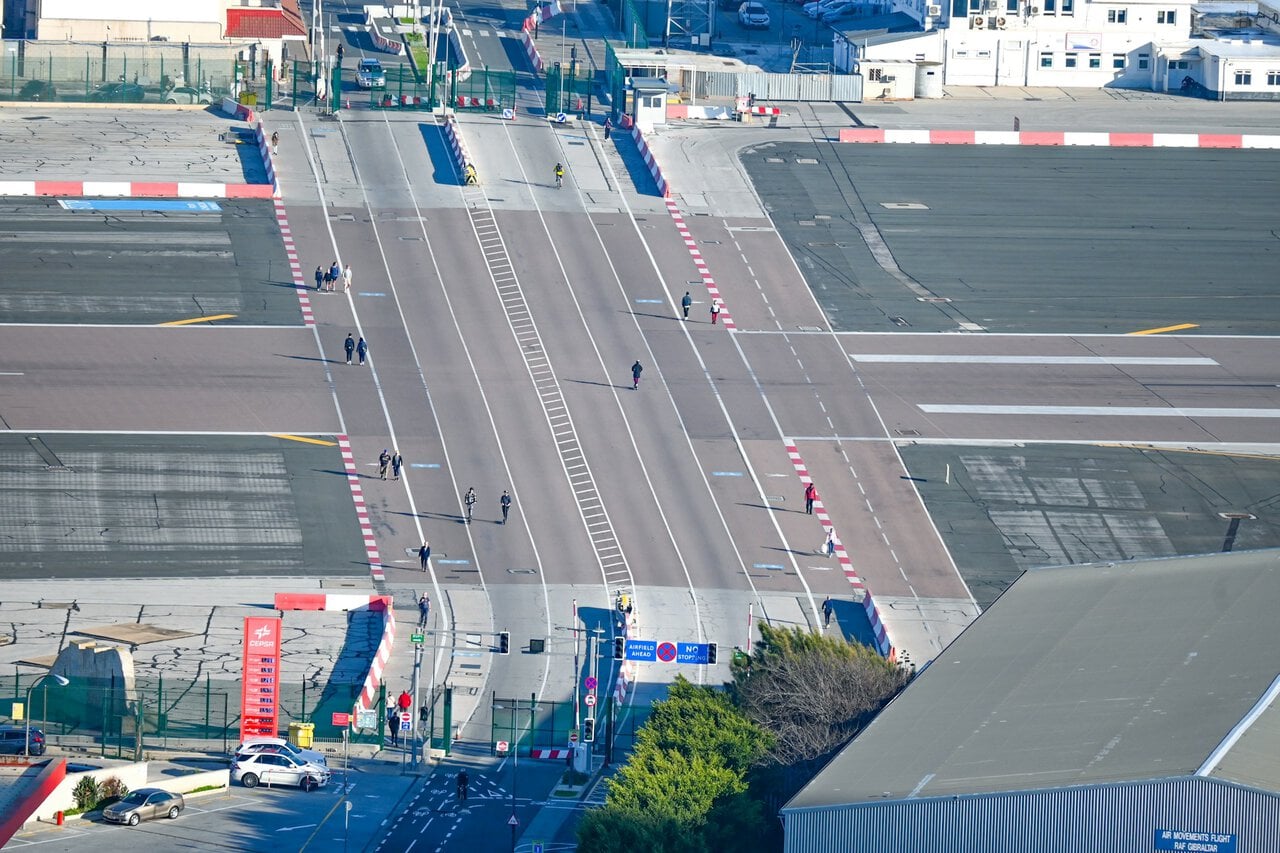
You will walk across the Gibraltar International Airport runway, which is one of the most unusual crossings in the world. This is an active runway, and when a plane is landing or taking off, barriers close and all pedestrians must stop and wait. When the runway reopens, you continue walking across it.
This is not just a functional crossing. It is a memorable part of visiting Gibraltar, and something most travellers remember long after their trip.
After crossing the runway, it takes around 15 to 20 minutes to walk into the centre of Gibraltar. The route is straightforward and takes you directly toward the main town area, where you will find shops, cafés, and transport connections.
Walking avoids many of the common problems associated with driving. You do not need to worry about traffic queues, parking availability, or navigating busy streets. Instead, you get a simple, direct, and often quicker entry into Gibraltar.
For day trips and short visits, walking across the border is almost always the best option.
Driving Across the Border and What to Expect
Driving into Gibraltar is possible, but it is important to understand that it can be significantly slower and more complicated than walking, particularly at busy times.
When approaching the border by car, you will need to join a queue to pass through border control. During quiet periods, this can move relatively quickly. However, during peak times such as weekends, school holidays, and summer travel periods, queues can become long and waiting times can increase to 45 minutes or more.
The delay is not the only issue. Once inside Gibraltar, you will also need to consider parking, which can be limited, especially near the centre and major attractions. This can add extra time and frustration to your visit.
For many travellers, the smarter approach is to park in La Línea and walk across the border. Parking is often easier to find and more affordable on the Spanish side, and the walk into Gibraltar is straightforward.
Driving may still be useful in certain situations. If you are continuing your journey beyond Gibraltar, travelling with heavy luggage, or need accessibility support, it can be the right choice. However, for most visitors, especially those on a day trip, it is not the most efficient option.
The reality is clear. Driving into Gibraltar can work, but walking is usually faster, easier, and far less stressful.
Best Times to Cross the Gibraltar Border
Timing your crossing correctly can make a huge difference to your experience. The Gibraltar border is not always busy, but when it is, delays can build quickly. Knowing when to cross is one of the easiest ways to save time and avoid frustration.
The quietest times are usually early in the morning and later in the evening. If you arrive before the main flow of day-trippers, you can often pass through the border quickly and start your visit without delays. This is especially useful if you are visiting Gibraltar as part of a day trip from Spain.
Mid-morning through early afternoon tends to be the busiest period. This is when tour buses, organised day trips, and independent travellers all arrive at roughly the same time. During these hours, queues can increase, particularly for vehicles, and the crossing can take noticeably longer.
Weekends and public holidays are also busier, as both tourists and locals move between Spain and Gibraltar. During peak summer months, this effect becomes even stronger, and crossing times can become less predictable.
If you want the smoothest experience, the best strategy is simple. Arrive early, avoid peak midday hours, and allow extra time if you are travelling during busy seasons. A small adjustment to your schedule can save a significant amount of time.
Crossing the Gibraltar Airport Runway
One of the most unique parts of entering Gibraltar is the experience of crossing the Gibraltar International Airport runway. This is not something you will encounter in most destinations, and it adds a distinctive and memorable element to your journey. If you want to gauge when the barriers are likely to close, Gibraltar International Airport publishes live arrival and departure times.
After passing through the border, pedestrians and vehicles must cross this active runway to reach the main part of Gibraltar. When there is no air traffic, the crossing is open and movement is continuous. However, when a plane is arriving or departing, the situation changes quickly.
Barriers close across the road and pedestrian walkway, and everyone must stop. This works in a similar way to a railway crossing, where safety takes priority. Once the aircraft has cleared the runway, the barriers reopen and crossing resumes.
The delays caused by this are usually short, but they can add a few extra minutes to your journey. During busier periods with more frequent flights, you may encounter this more than once.
Despite this, the runway crossing is not something to worry about. It is well managed, clearly signposted, and safe. In fact, many travellers see it as one of the most interesting parts of visiting Gibraltar, and it is often photographed and shared because of how unusual it is.
Understanding how this works helps you stay relaxed and prepared. It is a normal part of the Gibraltar experience, not an inconvenience.
Common Delays and How to Avoid Them
Delays at the Gibraltar border are usually caused by a combination of timing, traffic volume, and travel method. Understanding these factors will help you avoid the most common problems.
The biggest cause of delays is vehicle traffic. Cars, taxis, and tour buses all pass through the same crossing point, and when demand increases, queues can build quickly. This is why walking is often faster, as pedestrian lines tend to move more efficiently.
Another common issue is poor timing. Arriving during peak hours, especially mid-morning or early afternoon, means you are crossing at the same time as large numbers of other travellers. This naturally increases waiting times.
Documentation can also slow things down. Travellers who are not prepared with their passports ready may hold up the process, particularly during busy periods when border control needs to move people through quickly.
The simplest way to avoid delays is to focus on three key principles. Cross early where possible, walk instead of driving, and have your documents ready before you reach the checkpoint. These small steps can make a noticeable difference.
Being prepared does not just save time. It also makes the experience far more relaxed, allowing you to start your visit to Gibraltar without unnecessary stress.
Returning to Spain from Gibraltar
The return journey from Gibraltar back into Spain is often overlooked, but it can be just as important as entering. Depending on the time of day, queues can form in both directions, so it is worth planning your return as carefully as your arrival.
When leaving Gibraltar, you will pass through exit control on the Gibraltar side, followed by entry control into Spain. The process is usually straightforward, but during busy periods, particularly late afternoon, queues can increase as day-trippers begin to leave.
This is especially noticeable during peak tourist seasons and weekends, when large numbers of visitors return to Spain at similar times. Waiting times can increase, particularly for vehicles, and it is not unusual for delays to build during these periods.
If you are on a schedule, such as catching a train, flight, or returning transport, it is important to allow extra time for the crossing. Leaving Gibraltar slightly earlier than planned can help you avoid the busiest periods and reduce the risk of delays.
For those who walked across the border, the return process is usually quicker and more predictable. For drivers, queues can still be a factor, so patience may be required.
The key takeaway is simple. Plan your return crossing just as carefully as your arrival, and allow enough time to avoid unnecessary pressure at the end of your trip.
Search flights and useful route combinations for your trip.
View flightsUse an eSIM to get online without hunting for a local SIM after arrival.
See eSIM optionsHave a private airport pickup arranged before you travel.
Book a transferPractical Tips for a Smooth Gibraltar Border Crossing
Getting across the Gibraltar border is not difficult, but a few simple decisions can make the experience much faster and far less stressful.
The most effective approach for most travellers is to park in La Línea and walk across the border. This avoids vehicle queues, removes the need to find parking in Gibraltar, and gives you a more predictable crossing time. For day trips, this is usually the best overall strategy.
It is also important to carry your passport at all times and keep it easily accessible. Border control can move quickly during quieter periods, but delays often happen when travellers are unprepared. Being ready helps you move through the checkpoint efficiently.
Timing remains one of the biggest factors. Arriving early in the day will almost always give you a smoother crossing. If you arrive during peak hours, particularly late morning or early afternoon, you are far more likely to encounter queues.
You should also be aware of the runway crossing. While it is a highlight of the experience, it can add a short delay when flights are operating. This is normal and well managed, but it is worth allowing a little extra time in your plans.
If you follow these simple principles, you can turn what many people see as a complicated process into a quick and straightforward part of your journey.
Is It Better to Walk or Drive into Gibraltar
This is one of the most common questions travellers ask, and the answer is clear in most situations. Walking is usually the better option.
When you walk, you avoid the main cause of delays, which is vehicle traffic. Pedestrian crossings are generally faster and more predictable, and you do not need to worry about parking once you arrive in Gibraltar. The walk itself is straightforward and takes you directly into the centre.
Driving, on the other hand, introduces several complications. You may face queues at the border, delays caused by traffic, and limited parking options once inside Gibraltar. While driving can be useful in certain situations, it is rarely the fastest choice.
There are exceptions. If you are travelling with heavy luggage, require accessibility support, or plan to continue your journey beyond Gibraltar, driving may still be the right option. However, for most visitors, particularly those on a day trip, it adds unnecessary complexity.
The practical takeaway is simple. If you want the easiest and most efficient experience, walk across the border.

Rupert’s Handy Travel Tips
Rupert has crossed the Gibraltar border more times than he can count, and he knows that a little planning can save a lot of time and hassle.
- Walk across if you can: it is usually faster than driving and avoids long vehicle queues.
- Go early in the day: mornings are quieter and make the crossing much smoother.
- Have your passport ready: keep it in your hand, not buried in your bag.
- Allow extra time on the way back: queues into Spain can build later in the day.
- Enjoy the runway crossing: it is one of the most unusual parts of visiting Gibraltar.
Want to meet the reindeer behind our travel tips? Find out more in our page Who is Rupert?.


Frequently Asked Questions About the Gibraltar Border Crossing
Do you need a passport to enter Gibraltar
Yes, you must always carry a valid passport. However, since 15 July 2026 there are no routine checks at the land border itself — you simply walk or drive across. Immigration checks for non-Schengen travellers, including UK nationals, now take place via EU Entry/Exit System biometric checks at Gibraltar Airport and the Port of Gibraltar instead.
How long does it take to cross the Gibraltar border
Since the 15 July 2026 treaty removed routine border checks, crossing on foot or by vehicle is now typically a matter of minutes. The 10–45 minute waits described earlier in this guide applied before that date and are kept only as a historical record.
Is it better to walk or drive into Gibraltar
Walking is still usually the more convenient option. Border queues are no longer the deciding factor, as routine checks were removed on 15 July 2026, but parking inside Gibraltar remains limited, so many visitors park in La Línea and walk across.
Can you walk across the Gibraltar airport runway
Yes. Since 15 July 2026 there are no routine checks at the land border, so pedestrians walk straight across and then cross the runway. When planes are landing or taking off, barriers close and you must wait.
Is the Gibraltar border crossing busy
Not in the way it once was. Since routine checks were removed on 15 July 2026, crossings normally take only a few minutes at any time of day. Before that date the border could be busy during weekends, holidays and peak travel periods, with early mornings and late evenings usually quieter.
Further Reading and Related Travel Guides
Planning a visit to Gibraltar often works best when you connect your trip with nearby destinations and experiences. If you are travelling from southern Spain, our guide to Malaga to Gibraltar day trips explains the best routes, travel times, and what to expect along the way.
Once you arrive, exploring efficiently is key. Our Gibraltar in a day itinerary helps you plan your visit step by step, including how to see the Rock, the nature reserve, and the main highlights without wasting time.
For travellers focusing on experiences, you can also explore guides covering the Gibraltar cable car, dolphin watching tours, and guided Rock tours, all of which offer different ways to experience the territory.
Staying connected is also essential, especially when crossing borders. Using one of the best eSIM apps for travel allows you to avoid roaming charges and stay online throughout your trip without needing a physical SIM card.
By combining these guides, you can plan your visit more effectively and turn a simple day trip into a well-structured and stress-free travel experience.











