
Tower Bridge London Guide – What to Expect When You Visit
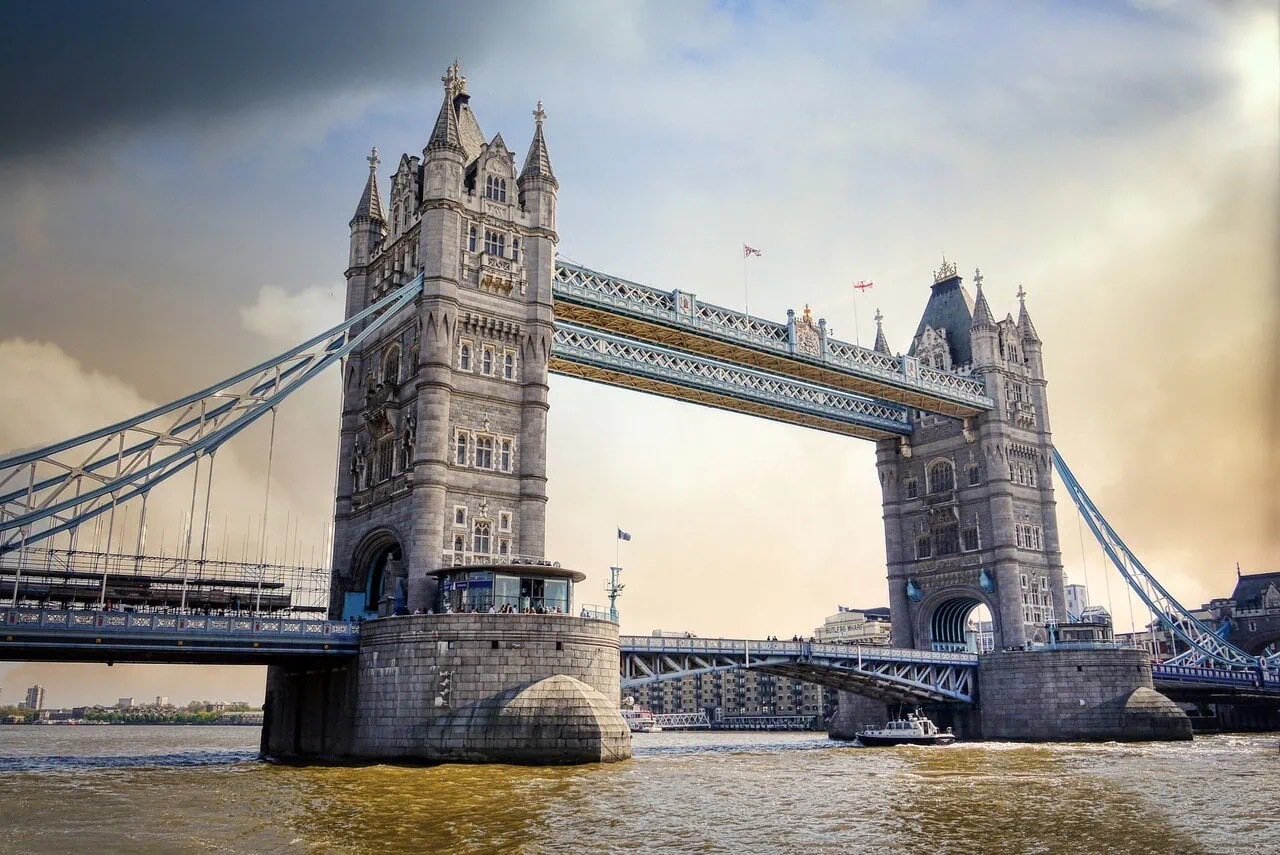
Tower Bridge London is one of the most famous landmarks in the UK and one of the most recognisable bridges in the world. Many visitors actually confuse it with London Bridge, which is a much simpler and less impressive bridge located upstream. Tower Bridge is the iconic one with two towers, high-level walkways, and the opening roadway that lifts for ships.
When you visit Tower Bridge, you are not just walking across a bridge. You can actually go inside the towers, walk across the glass floor walkway high above the Thames, and visit the Victorian engine rooms that originally powered the bridge lifts. This makes Tower Bridge both a historic engineering site and a viewpoint over London.
The bridge still opens regularly for large boats and ships, and if you happen to see it lift while you are nearby, it is one of the most memorable sights in London. The combination of Victorian engineering, river views, and the glass floor experience makes Tower Bridge one of the most interesting attractions in central London.
Most visitors combine Tower Bridge with the Tower of London, Thames river walks, or a river cruise, because all of these attractions are located within a few minutes’ walk of each other.
History of Tower Bridge
Tower Bridge was built in the late 19th century when London was expanding rapidly and there was a need for a new river crossing east of London Bridge. However, the River Thames was still a very busy shipping route at the time, so the bridge needed to allow ships to pass through. The solution was a bascule bridge, meaning the roadway could lift in the middle.
Construction began in 1886 and the bridge officially opened in 1894. At the time, it was considered an incredible piece of engineering. The bridge was originally powered by steam engines and hydraulic systems, which lifted the road sections to allow ships to pass through. Today, the system is powered by electricity, but the original Victorian engine rooms are preserved and can still be visited.
The two large towers were not just decorative. They were built to support the high-level walkways and the lifting mechanism. The walkways were originally intended for pedestrians to cross the river when the bridge was raised, although they were not used very often at the time.
Tower Bridge quickly became one of the symbols of London, particularly because of its distinctive Victorian Gothic design, which was chosen so the bridge would look good next to the nearby Tower of London.
Today, Tower Bridge is both a working bridge and a major tourist attraction, and it remains one of the most important and recognisable landmarks in London.
Why Tower Bridge Is Often Confused With London Bridge
One of the most common mistakes visitors make in London is confusing Tower Bridge with London Bridge. Many tourists arrive expecting London Bridge to look like the famous bridge with towers and walkways, but that famous bridge is actually Tower Bridge, not London Bridge.
The confusion happens because London Bridge is historically the more important bridge, and the name appears in the famous nursery rhyme “London Bridge is Falling Down.” However, the modern London Bridge that exists today is actually a simple, modern road bridge that looks quite plain compared to Tower Bridge.
Tower Bridge, on the other hand, is the iconic bridge with two large towers, high-level walkways, and a lifting roadway, and this is the bridge that appears in most photographs, films, postcards, and travel guides. Because it is so visually impressive, many people assume this must be London Bridge, even though it is actually located further east along the River Thames.
To make things more confusing, the original historic London Bridge was dismantled and sold in the 1960s and rebuilt in Arizona in the United States, where it still exists today in Lake Havasu City.
An easy way to remember the difference is simple:
Tower Bridge has towers. London Bridge does not.
Understanding this difference helps when navigating London, because the two bridges are about a 10–15 minute walk apart, and they are near different Underground stations and attractions.
Where Tower Bridge Is & How to Get There
Tower Bridge is located in east central London, next to the Tower of London, and crosses the River Thames between the City of London and the South Bank. It is one of the easiest major landmarks in London to reach and is very well connected by Underground, buses, and river boats.
The closest Underground stations are Tower Hill, London Bridge, and Bermondsey, depending on which side of the river you are approaching from. Tower Hill is usually the most convenient station if you are visiting both Tower Bridge and the Tower of London on the same day.
One of the best ways to reach Tower Bridge is actually by walking along the River Thames. Walking from St Paul’s Cathedral along the Thames Path, or from London Bridge toward the Tower of London, gives some of the best views in London and makes Tower Bridge feel like a natural destination at the end of a river walk.
Tower Bridge is also a stop on many Thames river cruises and Uber Boat services, which is another great way to arrive because the bridge looks particularly impressive from the water.
Because so many attractions are located nearby, Tower Bridge is usually visited as part of a Tower of London, river walk, and City of London sightseeing day rather than as a standalone attraction.
Tower Bridge Tickets & Entry Information
Many people think Tower Bridge is just a bridge you walk across for free, and while you can cross the roadway for free, the main attraction is actually the Tower Bridge Exhibition, which requires a ticket. This includes access to the towers, the high-level walkways, the glass floor, and the Victorian engine rooms.
The visit usually starts by going inside one of the towers, where lifts and stairs take you up to the high-level walkway. From here you can walk across the bridge high above the traffic and river, and this is where the famous glass floor panels are located. After crossing the walkway, you descend to the engine rooms, where you can see the original steam engines that powered the bridge lifts.
It is usually best to buy tickets online in advance, especially during weekends and summer, as the attraction is very popular and queues can form at the ticket office.
Tower Bridge is also included in some London attraction passes, which can be good value if you plan to visit multiple paid attractions such as the Tower of London, St Paul’s Cathedral, river cruises, or viewpoints like The Shard. However, attraction passes are not always the cheapest option, so it is worth checking our attraction pass comparison guide before buying one to make sure it actually saves you money.
Most visitors spend 1 to 1.5 hours inside Tower Bridge, and many combine the visit with the Tower of London, a river cruise, or a walk along the Thames on the same day.
What to See Inside Tower Bridge
When you visit Tower Bridge London, the experience is divided into three main parts: the tower exhibition, the high-level walkways with the glass floor, and the Victorian engine rooms. Together, these sections explain how the bridge was built, how it works, and why it became one of London’s most famous landmarks.
The visit usually starts inside the tower, where you take a lift up to the high-level walkway. Along the way, there are exhibitions explaining why Tower Bridge was built, how Victorian engineers designed the lifting bascules, and how the bridge changed the development of London’s docks and river traffic. The displays are well done and give useful historical context rather than just being a viewpoint attraction.
At the top, you reach the high-level walkways, which connect the two towers. These walkways were originally built so pedestrians could still cross the river when the bridge was raised for ships. Today, they are used as viewing galleries and exhibition space, and they offer great views along the River Thames toward The Shard, the Tower of London, HMS Belfast, and the City of London skyline.
The most famous part of the walkway is the glass floor panels, where you can look straight down at the traffic and boats passing underneath the bridge. Many visitors are surprised by how high it actually feels when you step onto the glass.
After crossing the walkway, you go down to the Victorian engine rooms, which are often one of the most interesting parts of the visit. Here you can see the original steam engines, hydraulic pumps, and coal-powered machinery that were used to lift the bridge when it opened in the 1890s. These engines are beautifully preserved and help you understand just how impressive the engineering was at the time.
Overall, the Tower Bridge exhibition is a mix of history, engineering, and views, which makes it more interesting than many people expect before they visit.
Tower Bridge Glass Floor Experience
The glass floor at Tower Bridge is one of the main reasons people buy a ticket to visit inside the bridge. The glass panels are located in the high-level walkway between the two towers, and they allow you to look straight down onto the road and the River Thames below.
Standing on the glass floor can feel quite strange at first because you can see cars, buses, and pedestrians moving underneath you, and the height makes everything look very small. However, the glass is extremely strong and designed to hold several tonnes of weight, so it is completely safe.
Many visitors take photos lying on the glass or standing directly in the centre panel. If the bridge happens to open while you are inside the walkway, you can sometimes see the bascules lifting from above, which is a very unusual and memorable view.
Even if you are not normally interested in engineering or bridges, the glass floor experience is something quite different and is one of the reasons Tower Bridge is more than just a historic landmark.
Best Views of Tower Bridge (Photo Spots)
Some of the best views of Tower Bridge London are actually from outside rather than from inside the exhibition. The bridge is one of the most photographed landmarks in London, and there are several excellent viewpoints nearby.
One of the best views is from the Tower of London side of the river, where you can see the full bridge with the river in front of it. This is particularly good in the evening when the bridge lights come on.
Another great viewpoint is from the South Bank near City Hall and Potters Fields Park, which gives a slightly angled view of the bridge and is one of the best places for photos.
You can also get great views of Tower Bridge from London Bridge, especially looking east along the river, or from Thames river boats, which often pass directly under the bridge.
At night, Tower Bridge is illuminated and looks completely different, so if you are in the area in the evening, it is worth seeing it again after dark.
Tower Bridge is one of the few landmarks in London that looks impressive from almost every angle, which is why it appears in so many photos and films set in London.
How Long to Spend at Tower Bridge
Most visitors spend 1 to 1.5 hours visiting the Tower Bridge Exhibition, including the towers, walkways, glass floor, and engine rooms. If you are only walking across the bridge and taking photos from outside, you might only spend 20–30 minutes in the area.
Tower Bridge is very close to several major attractions, so it is rarely visited on its own. Most people combine it with the Tower of London, a Thames river cruise, a walk along the South Bank, or a visit to The Shard or Sky Garden.
Because everything is close together, this area is often part of a full day of sightseeing along the River Thames, starting around St Paul’s Cathedral, walking east along the river, and finishing at Tower Bridge and the Tower of London.
If you plan your day well, Tower Bridge usually fits very easily into a London itinerary without needing extra travel time, which is one of the reasons it is such a popular attraction.
Nearby Attractions
One of the best things about visiting Tower Bridge London is that it sits in one of the most historic and scenic parts of the city. Several major attractions are located within a short walking distance, which makes it very easy to plan a full day of sightseeing in this area.
Right next to the bridge is the Tower of London, one of the most important historic sites in the UK and home to the Crown Jewels. Many visitors visit the Tower of London and Tower Bridge on the same day because they are only a few minutes’ walk apart and are closely linked historically.
Just along the river on the south side of the Thames you will find HMS Belfast, a historic Royal Navy warship that is now a museum. You can walk along the riverside path from Tower Bridge toward London Bridge and pass several viewpoints, cafés, and river cruise piers along the way.
A short walk from the bridge on the north side of the river takes you to St Katharine Docks, a small marina surrounded by restaurants and cafés. This area is much quieter than the main tourist streets and is a nice place to stop for food after visiting the bridge.
You can also walk west along the river toward London Bridge, The Shard, Borough Market, and the City of London, which makes Tower Bridge a good starting or finishing point for a Thames riverside walk.
Because so many attractions are located close together, this area is one of the easiest parts of London to explore on foot without needing public transport.
Tower Bridge Visitor Tips
Visiting Tower Bridge London is quite straightforward, but a few simple tips can make your visit much smoother and more enjoyable.
One of the best tips is to check the bridge lift times in advance. Tower Bridge still opens regularly for large boats and ships, and watching the bridge lift is one of the most interesting things to see. The lift times are published on the official Tower Bridge website, so if you plan your visit around a lift, you can see the bridge open from either the riverbank or the high-level walkway.
If you plan to visit the exhibition inside the bridge, it is usually best to book tickets online in advance, especially during weekends and school holidays. This can save time and help you avoid queues.
If you are visiting the area, try to walk across Tower Bridge both during the day and in the evening. The bridge looks completely different when it is illuminated at night and is one of the most impressive night views in London.
Another useful tip is to walk along the South Bank after visiting Tower Bridge, because this riverside walk toward London Bridge and Borough Market is one of the nicest walks in central London and gives great views back toward the bridge and the City skyline.
Finally, remember that Tower Bridge is very exposed to the wind because it crosses the river, so it can feel much colder here than in other parts of central London, especially in winter.

Rupert’s Handy Travel Tips
Visiting Tower Bridge? Here are a few tips to make your visit smoother:
- Check bridge lift times: Seeing Tower Bridge open for a ship is one of the best things to see in the area.
- Walk across at night: Tower Bridge is illuminated in the evening and looks completely different after dark.
- Combine with the Tower of London: The two attractions are next to each other and easy to visit on the same day.
- Walk the Thames Path: The riverside walk toward London Bridge and Borough Market is one of the best walks in central London.
Want to meet the reindeer behind our travel tips? Find out more in our page Who is Rupert?.
Further Reading & Related Guides
If you are visiting Tower Bridge London, you will almost certainly also visit the nearby Tower of London, as the two attractions are located next to each other and are closely linked historically. Visiting both on the same day is very easy and is one of the most popular sightseeing areas in London.
Many visitors also combine Tower Bridge with a Thames river cruise, which allows you to see the bridge from the water and travel easily between attractions such as Westminster, the London Eye, St Paul’s Cathedral, and Greenwich.
If you are planning your trip, it is also worth reading our London attractions guide, which helps you plan your itinerary and group nearby attractions together so you do not waste time travelling across the city unnecessarily. If you are visiting for a short trip, our London in a Weekend guide can help you prioritise the most important attractions and plan your time properly.
Reading these guides together will help you plan your London itinerary more efficiently, group attractions by area, and make the most of your time in London.
Last Updated
April 2026
Affiliate Disclosure
This page contains affiliate links. If you click through and make a purchase or booking, we may earn a small commission at no extra cost to you. This helps support our work and allows us to continue providing detailed, independent travel advice. We only recommend apps and services we personally use or have verified as high-quality.